Monday, 1 September 2014

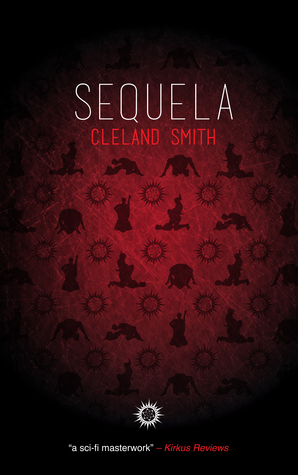
Sequela by Cleland Smith

Sequela is not a fancy plural of 'sequel' - I had to look it up to find that it means a slow / long-term / delayed effect of a medical condition. So, for instance, the herpes virus attacks the nervous system, which may result in brain damage that leads people to be unable to recognise animals, and other long-term harm to the brain. Which makes Sequela a great and fitting title of this novel, but it's still a word I doubt everyone knows.

The book tells the story of a scientist who moves from public-sector-funded academic research into commercial viral design in the private sector. Set in a future London which is strictly divided into The City (i.e. yuppieland) and the outside, with security checkpoints and all kinds of (legal, physical and social) barriers between the two, his job is to create sexually transmitted viruses(STVs). In this future, STVs have become fashionable - they indicate whom one has slept with, which in turn indicates a connection to power. Each symptom pattern is linked to different powerbrokers, and every 'player' is trying to have the most prestigious rash pattern. Our hero, however, has different ideas for what viruses could be used to achieve: instead of rashes, they could make the wearers more beautiful - and cement the fashionability of infections.

This is also a world where infections are a choice - people have implants that replace their immune systems and screen for viruses, giving them control over what they do and don't allow to affect their health. The implants, of course, are expensive, and only the well-off have them. As a hobby, our hero wants to create a different method to work the immune system, through easily transmitted viruses, rather than expensive artificial implants.

It's high concept, but really, this is a character-based thriller. The book starts with a tense job interview and grows from there, never letting up tension, and indeed driving it up with every chapter. The tension comes from social interactions, from office politics, from personal relationships and how they develop - as well as the threat that viruses (and viral attacks) represent.

It's stunningly realised, with each character believable and not always predictable, each social interaction authentic and natural, each dialogue utterly convincing. All that, and with a plot that gradually gets more and more tense, without ever descending into action-movie blockbuster nonsense.

I'm very, very impressed with the craftsmanship of this novel. I would cheerfully recommend it to anyone with an interest in scifi and some tolerance of occasional sex in literature: although it stays broadly unpornographic in descriptions of the encounters, the text is necessarily full of sexual events.

Rating: 5/5

Thursday, 28 August 2014

The Incorruptibles by John Hornor Jacobs

The Incorruptibles mixes a huge variety of aesthetics:


  • Steampunk (think Jules Verne and HG Wells inspired retro scifi)
  • Riverboat Journey in the US (think Huck Finn)
  • Western
  • Romans 
  • Demons & Possession Horror
  • Elves 


Seriously. This is a 19th-century-style universe where Romans.... pardon, 'Rumans', have conquered much of the world, and are in perpetual competition / conflict for dominance with the Chinese empire. We follow a bunch of Romans on their demon-powered riverboat as they travel, accompanied by our narrator and his friend, the cowboys / scouts. They encounter Injuns... pardon: natives (who have superpowers: unnatural healing, speed and strength, and who are extra tall). Their technology (guns and steam) is powered by demons...

This book throws a gazillion genres together (if Joss Whedon can do cowboy space opera, why not a steampunk Roman demonic horror story with elves?). Unfortunately, it does not throw them together in a particularly interesting story. The characters are fairly boring. The story spends an awful lot of time lacking direction. There is action, but not much tension, for much of the book. And ultimately the genre combo seems overly contrived. This book, with a super promising cover and exciting blurbs, sadly does not deliver the joy it promises.

Rating: 3/5

Monday, 18 August 2014

The Tale of the Dueling Neurosurgeons by Sam Kean

The Tale of the Dueling Neurosurgeons is a slightly misleading title: there is not a single incident of dueling neurosurgeons in the book.

As a non-fiction, popular science primer on neuroscience, however, the books is splendid. I've heard quite a few of the anecdotes / case studies before, but this book pulls together all the incidents and anecdotes that have shaped neuroscience, and presents them in an engaging, fun way. It's like a "Horrible Histories" book for adults.

The book is not too bothered about chronological order; instead, it presents the knowledge obtained thus far by brain region and by type of brain functionality. This works very well - but it does give a somewhat more logical and structured impression than the history of neuroscience and its theories probably warrants. And there's always the sense that bigger, clearer discoveries might be just around the corner...

Many of the scenarios do resonate with me as a reader & movie watcher: clearly, the likes of Hitchcock and Philip K Dick were inspired very much by real conditions - and the effectiveness of uncanny stories is directly linked to how closely they resemble everyday (or not-so-everyday) brain misfirings...

I'd highly recommend this book to anyone - it is a compelling, entertaining and educational read: pop science as it should be done.

Rating: 5/5

Tuesday, 12 August 2014

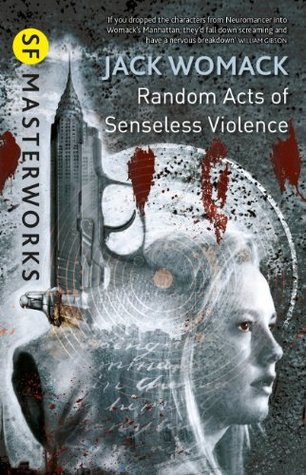
Random Acts of Senseless Violence by Jack Womack

Random Acts of Senseless Violence is a novel in the form of a diary of a teenage girl living in New York. She receives it as a birthday present, and chronicles the next six months of her life. They are eventful six months, both for her, personally, and for the wider US: caught in a long-term recession and decline, stability is crumbling and pockets of violence and societal collapse are forming at the edges. Her own family is just about to descend from lofty upper middle class to struggling working class, as her parents' exuberant and careless spending habits and debts catch up with them.

It's a bit strange to read Random Acts of Senseless Violence. It was written in the mid-1990s, before the internet and mobile phones became truly universal, yet set slightly in the future, without any real technological advances. In some ways, this enhances the novel: it does not get caught up in the blips and fads and things that are quickly replaced in our lives. No Twitter and Bebo and Ello to be found. This makes it more universal. On the other hand, it makes it feel slightly old-fashioned, as characters rely on landline phones in ways that now feel entirely alien to most readers.

The universal feel makes the authenticity of the story - and its prescience - all the more unsettling. Our protagonist's family tumbles from debt-bubble-financed luxuries down to a fragile, easily exploited situation, and as reader, you realise just how precarious their situation was just before the tumble began - and just how rapidly things are sliding out of control. The downward spiral is mirrored - or perhaps caused - by the terminal decline of the entire US economy, but of course, our teenage narrator only perceives tiny glimpses of the wider world in her diary, snippets from the news and overheard conversations and adults' anxieties. We're presented with adults who are over-medicated, stressed to near-breaking point, and a sense of widespread, near-universal mental ill-health. Adults are cracking up, and the children are not sure what to make of it. At one point, our narrator notices that adults seem to be all crazy, and comments that she can't afford to get any more crazy herself.

(The widespread mental ill health rings worryingly true in these times of London riots, Islamic State, post-Arab Spring civil wars, and rise of UKIP, Britain First, Tea Party, and other extremist movements throughout the wealthier world...)

Meanwhile, there's the matter of puberty (the diary carefully notes each instance of her period, as a teenage girl perhaps might), and sexual awakening, and peer pressure, bullying, domestic abuse, isolation...

Random Acts of Senseless Violence is a masterpiece of writing craft: its characters and story developments are absolutely believable and authentic, echoed worryingly in things that have come to pass in recent years: the debt bubble, recession, collapse of the Rust Belt / Detroit and New Orleans, the riots in London and the Occupy Movement, the political leaders who seem impotent to turn things around and who look increasingly haunted by their own impotence, holding on to power despite widespread disillusion and protests... but a much more compelling feat of writery craftsmanship than its prescience is the gradual, subtle and entirely radical shift in the narrative voice. This teenager is meeting new people, and her vocabulary, her sentences, her speech patterns, her entire language changes. At first, she simply reports the dialogue, but slowly, one tiny step at a time, her own lines of dialogue, and then her entire writing voice, shift, until by the end, you are reading something which is unrecognisable when compared with the start. The later diary entries are the writings of a different person who somehow emerged by coming of age in that time and that place and through those events...

...all of which does not mean the book is actually fun to read. It is enormously talented, clever, a masterpiece of craftsmanship - but the sort of work you appreciate, rather than enjoy. I cannot praise the genius of the book highly enough, but I can't claim that it made me feel good while I read it. And, to me, the entire point of reading is about enjoyment (even if a story is dark or harrowing). This book is simply a bit too relentlessly troubling for me.

Rating: 4/5

Friday, 8 August 2014

Dream London by Tony Ballantyne

Dream London is a book unlike any I have read before. It's as if the author had thrown together Dark City, Brazil (the Terry Gilliam Movie), a dash of Yellow Submarine, and a dose of Neil Gaiman style urban fantasy into a concoction that is dream-like, unpredictable, surreal, and yet strangely hypnotic and quite readable. Female readers be warned: the dream-world presented here is quite misogynistic and definitely extremely sexist in its aesthetic / tone / fundamental architecture. But it's also aware of the fact, and this is being highlighted many times in the book (just as all the 'ethnics' are being condensed into stereotypes).

The basic plot is that Captain James Wedderburn, former soldier and current pimp, suddenly attracts the interests of various entities - a Cartel, a crime overlord (the Daddio), spies, and Angel Tower - the building where Dream London is being made. The city has somehow been sold, and is shifting, geographically, but also in time and flavour, and people are changing. Everyone is becoming a stereotype. The women become whores and cleaners and other archetypes. The men become football hooligans or pimps or men in suits. Everyone finds their humanity shrinking as existing traits become honed into archetype-level one-dimensionality, and Dream London has a certain, sleazy, seedy, almost steampunky aesthetic it is growing towards. And in that strangely drifting London, some people want to reverse the drift, return to modernity, while others want to capitalise on the changes, and everyone suddenly has an interest in getting Captain James Wedderburn to act as their catalyst / agent / hero.

But, as any dream, the story ebbs and flows and shifts and changes. It circles around, but when it revisits a location or a character, they are different from the way they were before, and like any nightmare, there is no way to escape, just a slowly building sense that something ominous is about to happen.

Dream London became harder to stick with the longer the story continued, because the dream-like nature is not just authentic but also frustrating. Just as movies like The Fall and Brazil and perhaps even Casino Royale slowly drift into surrealism and with it, narrative discomfort, so Dream London flows steadily away from a clean premise and into an atmosphere that isn't quite right. The grand finale is perfectly dream-like, too.

I thought the book was very well-written, imaginative, and authentically dream-like - in some ways, a masterpiece. But, just like a semi-nightmarish dream of running and frustration, it has an aftertaste. There is much to enjoy here, and much cause to cringe and fret, too.

Rating: 4/5

Saturday, 12 July 2014

Three Graves Full by Jamie Mason

Three Graves Full is a novel that really wants to be a comedy movie. Jason, our protagonist, is a meek man who, in a rare fit of rage, has murdered someone and buried him in his back yard. A year later, someone discovers a skeleton - in his front yard.

The book continues the tale of hapless Jason, and adds various other characters (the ex-girlfriend of one of the victims, two police officers, a dog...), and creates a web of unlikely events that have the general feel of a Guy Ritchie movie (or perhaps an indie movie) - except it's all set in America.

It's a pleasantly diverting, vaguely entertaining yarn, marred by being somewhat overwritten. The writer seems to be a beginner - the prose itself is frequently clunky and over-reaching, but there's also a tendency to give detailed back stories of each character and event, often filling in details that weren't really needed. It's also a book that yearned to be laugh-out-loud funny, but wasn't.

A promising premise, not quite lived up to.

Rating: 3/5

Wednesday, 9 July 2014

Eight Men and a Duck by Nick Thorpe

In the non-fiction book Eight Men and a Duck, a journalist has a chance encounter with a confident, gung-ho adventurous American, and decides to join the American's quest to cross from Chile to Easter Island in a reed boat, inspired by Thor Heyerdahl's Kon-Tiki adventure (which never actually landed on Easter Island).


The book reads like someone telling a yarn to his mates. It's chummy, everyone's improvising, a bit inept, and hugely reliant on luck. The quest is about as wise, responsible and well-prepared as the adventures in the Hangover movie series, but there's less humour.

It's not really a scientific thing: it's people having an adventure for adventure's sake.

Once the only vaguely skilled person left the team (frustrated with his companions' habit of winging it and lack of preparation / forethought, and the resulting delays), the narrative lost a lot of interest for me. Basically, I didn't really like any of these guys all that much, as I could not respect them.

It's not a bad book, but it doesn't really have anything much to say: A bunch of bumbling young men seek adventure and succeed mostly through luck. The end.

Rating: 3/5