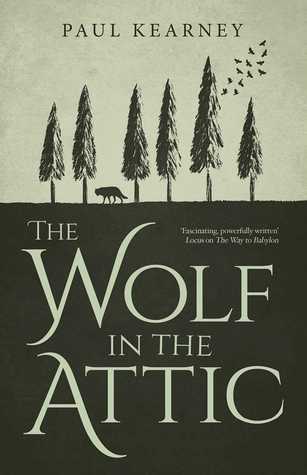
The Wolf in the Attic is a novel about Anna, a refugee girl living in 1920s Oxford with her father. She only dimly remembers her life before the catastrophe that brought her to England, and, home-schooled by a governess, she does not have much contact with other children. Looking for an adventure, she sneaks out into the fields and forests around Oxford in the middle of the night, only to come face to face with something scarier than she'd ever expected, and people who seem to live more mythical, ruthless and dangerous lives.
The blurbs in some places mention CS Lewis and JRR Tolkien, who live in the same Oxford as Anna. Indeed, they make cameo appearances in the book. However, this isn't their story. Their appearances add very little to the plot. To be honest, I think it might have been wiser to cut them out entirely: mentioning Narnia or Tolkien will nudge reader expectations into certain directions. The Wolf in the Attic, however, is too different in its perspective.
Anna's encounters take place in our world. The strangers she meets may live differently, but they wander through the same landscapes and the same Britain that we live in. Don't think Narnia. Think Pan's Labyrinth, Alan Garner or some of the more restrained urban fantasy you might have read / watched. Meanwhile, Anna's adventures don't feel safe the way Narnia ones do, nor epic in the same way that Middleearth ones are.
Paul Kearney is a fascinating writer, tackling the intersection of the otherworldly with our own world with care and a lot of thought. He's written several novels for adults which handle such stories with more complexity than most: A Different Kingdom and Riding the Unicorn. The Wolf in the Attic is a novel for Young Adults, but it, too, thinks about the grittier aspects of its type of story. In his adult novels, the protagonists are a wife-beating prison guard and a man whose youthful adventures in another world leave him broken. In the Wolf in the Attic, our heroine is a not-entirely-welcome refugee girl with a difficult father, going through puberty (in all its sticky, inglorious detail). Make no mistake: this is no flimsy light entertainment. This is literary literature.
There's a lot to appreciate about this book: having a refugee as heroine is certainly timely - and a reminder that refugees come from all kinds of backgrounds and places. Anna's family are Greeks from Smyrna, which was burnt down and subjected to massacres and is now called Izmir: I had never even heard of Smyrna, so the book made me look things up and educated me about an aspect of history I'd been entirely ignorant of. As for the fantastical elements, they are evocative and primal, as they should be.
That said, at times I struggled to keep reading. It throws a few too many ideas into one story. Once you mix up several different archetypal strands, you lose the beautiful clarity that a single strand can add to a tale. This is the trap that The Wolf in the Attic falls into - too many myths and ideas produce a confusing brew of a novel. The cameos of legendary Oxfordian authors is one example of an ingredient that didn't quite fit. There are others, but they would be spoilers.
To be honest, I'd recommend Paul Kearney's earlier novels: their themes are more coherent and, though serious, they never dragged. The Wolf in the Attic is not a bad novel. It's clever and interesting and has a lot to recommend it. Sadly, the mix of ingredients is not quite right.
Rating: 3/5
Sunday, 27 March 2016
Wednesday, 23 March 2016
Book Review: Every Heart a Doorway by Seanan McGuire
Every Heart a Doorway is a much-anticipated YA novella about a magical boarding school for girls who've returned from adventures in fantastical worlds. Seanan McGuire, who also writes as Mira Grant, is known for writing original, quirky, fun novels, filled with witty characters who have snappy repartee. A bit like the original Scooby Gang in Buffy.
Right from the first glimpse of the cover, there's a sense that Every Heart a Doorway is aiming higher than usual. Seanan McGuire's stories are always fun and fast-paced, but this time, there's a sense that the author is not just aiming to entertain, but to write something memorable and touching and meaningful.
The premise interrogates common fantasy tropes the same way that, for example, The Rest of Us Just Live Here does. There's a real, intelligent engagement with the trope, taking the premise quite seriously. Many of the most iconic stories about kids entering fantasy worlds have young girls on the cusp of puberty / adulthood as their protagonists. (A fact which has inspired other authors to write pornography about these travelling girls). Unsurprisingly, one of the questions the story handles is the why and wherefore of this pattern. What does it say about our societies, and what does it say about girls?
But it wouldn't be a Seanan McGuire story if it just focused on meta-analysis and literary critique. Every Heart a Doorway is many things, but its plot engine is a serial killer murder mystery. You barely get time to adjust to this unique school and its memorable residents before gruesome murders start to occur. At the same time, our young characters grapple with issues of sexuality, asexuality and trans-sexuality, romance and love. Plus, of course, the all-consuming longing to find their ways back to those magical worlds where they found, temporarily, a real home for their true selves...
Every teenager in the story is quite self-absorbed, so when murders do occur, they do not grieve as much as I first expected. As much as the cover and title hint at a deep and emotive story, it turns out that these magical travellers are not quite able to connect with others. Their main motive in trying to solve the murders isn't justice, nor even their own safety, but preserving the independence of their school, so they can continue to have this friendly safe space to recover from the trauma of separation from their worlds. Survival is a secondary consideration. Justice does not feature at all. Perhaps the somewhat shallow connections between characters appear this way because our main protagonist is a goth girl who has only just returned from her fantasy world, and whose every instinct is to stand by, to be removed, to be background. She's completely uncomfortable about being dragged into the centre of a story. There are hints that other characters have stronger connections, but even so, there is a sense of hollowness about many of them: they may have returned from their worlds, but they have not returned unscathed.
Every Heart a Doorway is a story of longing, of not belonging, of friendship, of adolescence, and of murder. It's a novella that packs more ideas in its short length than many a full-length novel, while keeping the reader entertained with witty repartee and fast prose. Its main flaw is that it is far too quick: as a reader I wanted to spend more time in this world with these characters. I wanted the immersion to be richer, longer-lasting, deeper.
Rating: 4/5
Sunday, 14 February 2016
'A Natural History of Dragons: A Memoir by Lady Trent' by Marie Brennan
A Natural History of Dragons is a novel set in a fantasy world that's broadly similar to late Regency / early Victorian era Europe, except all the place names are different. In this world, Lady Trent grows up in Scirland (England), developing an unseemly fascination with nature and critters and especially dragons from a young age. As the only daughter in a house full of boys, is it any wonder she's a tomboy at heart, much to her mother's despair?
This, then, is a memoir covering the tomboy years and early adulthood of a young woman in Regency(ish) times. We know from the outset that she will survive (after all, she is writing these memoirs in her old age), and that she will become a famous naturalist and unconventional, even infamous woman. This might impede the novel's ability to create tension, but curiously, it doesn't prevent it from being engrossing. It achieves a slightly mellow, but joyful reading experience.
In line with the memoir style, there are no villains for much of the tale. The story is driven by a curiosity about its world rather than traditional quests and adventures. The most adversarial element is society, and the expectations of men's and women's roles, during this time. Lady Trent is incredibly fortunate, because even though society would not normally let her flourish, she is very much beloved of those around her, and especially those with some degree of power over her. She is thoroughly unsentimental herself and does not seem to notice just how much certain people love her. Their love gives her freedoms she could never have expected to obtain in any other situation.
The writing voice is pleasant, the novel engrossing despite its mellow pace, the story fairly joyful. I think some of that joy comes from the fact that, as a reader, I may have fallen ever so slightly in love with Lady Trent. An unconventional young woman, a bit of a tomboy, a lover of books and knowledge and exploration? How could I resist the temptations of such a character?
Delightful.
Rating: 4.5/5
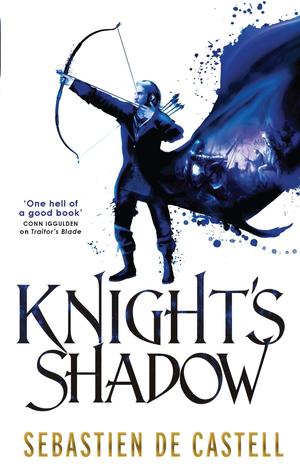
Knight's Shadow by Sebastien de Castell
Knight's Shadow is the second book in the Greatcoats series. I read the first, Traitor's Blade, quite a while ago, enjoying it at the time, despite noticing a few flaws / rookie mistakes.
Enough time has passed that I didn't recall details of Traitor's Blade's plot when I picked up Knight's Shadow. I did remember the setting, but little else.
The Greatcoats live in a fantasy world where justice was once dispensed by travelling judges, who were also master combatants. These judges, the Greatcoats, had been put in place by a king who, in turn, had taken the idea from history, reinstating an order of servants to the crown that had been dissolved centuries ago. Wandering from town to town, adjudicating conflicts, investigating crimes, duelling with local champions (if their verdicts were challenged to a trial by sword), carrying out sentences and setting them to tunes and singing their verdicts - these judges are not like any other I have encountered in fantasy literature. Imagine a sort of minstrel order of Judge Dredds, only with an irreverent sense of humour, tongue in cheek, and a lots of swashbuckling gusto.
In the aftermath of the king's deposition and murder, the Greatcoats have been dispersed, each with a final command of the king in his or her ear, to carry on his legacy despite persecution and hostile nobility and knighthoods. Across most of the country, they are deemed traitors for their support of the king's rule.
All of this is the backdrop to book one. Book two picks up where the first left off - but even having forgotten much of the plot, I was able to enjoy it. Falcio, our hero, has discovered an heir to the throne, a young girl named Aline, in the first book, and saved her life. Now, with the aid of the mysterious 'Tailor' - mother of the king and general of an army of sorts - he wants to continue protecting her and work towards putting her on the throne. Their enemies, however, are numerous, with a young witch duchess the most sadistic and ruthless of the lot.
Some things stand out about the Greatcoats books. Our heroes, Falcio, Kest, Brasti, and whoever joins their jolly gang, are quite fun to be around. Irreverent dialogue, banter, built on deep friendship: they're an ensemble that could have been written by Joss Whedon or William Goldman (of The Princess Bride fame). They might live in a world that's partially inspired by the machinations of George R R Martin-esque nobles, but they give the novels much needed levity and a big heart.
Even so, they do live in a twisted world, where those with power are mostly psychopaths or sadists or both. As such, their adventures do take grim turns from time to time. Violence gets gory, gruesome tortures abound.
I did enjoy the Knight's Shadow a lot. There were still a few rookie mistakes: two massive plotholes, in particular. However, it's a confident and fun novel, with plenty of momentum to keep you reading. I get the impression this series might be close to reaching parity with Scott Lynch's Gentlemen Bastards books, in terms of fun and addictiveness.
Rating: 4/5
The Plotholes:
SPOILER ALERT, obviously.
At one point, Falcio and the Greatcoats are in the palace of Luth, where it turns out the Duke has been murdered and the Duchess is dying. They are surrounded by Knights and taken to the Duchess (at her command). She tells them some plot. And then, in the next scene, they are rushing through the country to catch baddies and prevent atrocities. Except, how the heck did they get out of Luth alive? The Duchess was dying and the Knights had promised them death. It's not as if the Duchess would have ordered her Knights to let them go...
And the second spoiler concerns the Dashini assassin who leads them to the monastery. Only successful assassins are allowed an honorable outcome there. The Duke was supposedly his first victim (who hired the assassin, considering this would have had to happen before Falcio killed the two Dashini in book one?), and he had failed to kill the Duke, so, technically, shouldn't he be counted among the Unblooded? His leading Falcio to the monastery would therefore be against their rules...
Tuesday, 2 February 2016
Ace, King, Knave by Maria McCann
Ace, King, Knave is a historical novel set in 1760s London. The main protagonists are two women: Betsy-Ann and Sophie. The third viewpoint character is a fifteen year old black slave boy, called Titus / Fortunate.
At the start of the novel, Betsy-Ann is a street peddler, selling second hand goods, fencing the odd stolen knick-knack, while squirrelling away her most valuable and treasured possessions in hidden hidey-holes in the flat she shares with Sam Shiner. Sam is not legally her husband, although she has gotten used to using his surname instead of hers. When Sam tells her that he is getting into business with her brother, she is mortified: her brother is a rough, violent sort, and his business is graverobbing. The work leaves its mark on Sam - he starts to rely heavily on alcohol, and the smell of the dead follows him home. As Betsy-Ann's domestic life becomes more troubled, she recalls the road that led her to that little flat in London.
Sophie, meanwhile, is a young woman of nobility and upper class. Her story starts with romance and courtship and the road to marriage. Sophie initially finds it all so very blissful, but marriage soon starts to be oddly isolating. Her husband, Ned Zedlander, is busy all day (how strange for a nobleman to have so much to do!), and keeps her away from society, peers and family, much to her growing frustration.
Historical novels tends to have a more stately pace than the speculative fiction ones I usually read. Ace, King, Knave is no exception. A lot of energy is invested in worldbuilding and using authentic phrases in dialogue. The characters all seem perfectly convincing. As a piece of writing, Ace, King Knave shows great craftsmanship and attention to detail. It is a very accomplished work.
However, for all its impressive qualities, the story is quite bleak. Not, perhaps, quite as grim as Maria McCann's debut masterpiece As Meat Loves Salt, but neither is it the playful romp that the description and cover of the book led me to expect. Gamblers and graverobbers, women protagonists searching for the truth: I expected something with a bit more of a spring in its step when I bought the book. I also hoped for the plot to be rather more empowering of its women & slave protagonists than it was. I guess I'm too used to fantasy novels imagining better versions of the past, whereas this historical novel takes historical authenticity very, very seriously.
In the end, Ace, King, Knave is an excellent work of literary, historically accurate fiction, but less satisfying as a piece of entertainment. It was never a chore to read, but it left me feeling empty and hollow inside, which wasn't what I had expected.
Rating: 3.5/5
Wednesday, 27 January 2016
Spark & Carousel by Joanne Hall
Spark and Carousel is the story of two youngsters. Spark is a former apprentice of a powerful sorcerer, on the run. Carousel is a former street rat, making her living as street acrobat, working for one of the gangs of the city.
It's also the story of the two sorcerers trying to find Spark, the city's ruling family and their youngest daughter, with substantial story arcs involving merchants, landlords, gangmasters and other inhabitants of this world.
From the book cover, with its dusty colour palette and a font that just screams Old West, you might expect to read a novel about the frontier, about fantasy cowboys and Injuns. This expectation would be misplaced. The story does feature some travelling, but most of it takes place in a big city, full of taverns and inns, street rats and markets. It's a fantasy world, but with its river barges, noble families / petty aristocracies, and a sense of relative stability, it feels distinctly more European, more akin to pre-industrial Southern Europe than the Wild West.
There are some things that make Spark and Carousel stand out from other fantasy novels. We meet characters of every class, from the lowest street rats to the highest aristocrats, and it is the interactions and intersections between the different characters's lives that drive much of the plot. Each character has reasons for the things they do. There is evil, but it is not the evil of a moustache-twirling villain. Instead, the evil is a bi-product of characters' actions and desires. Some is unleashed by accident, other evil deeds start out as self-defence, against oppressive and abusive situations. On the other hand, some of the 'good guys' are distinctly flawed. Noble, a black gang master, inspires and demands great loyalty and strives hard to earn and repay this loyalty, but he is also a pimp and a gangster, perfectly ruthless in the pursuit and punishment of the disobedient. Finally, there is realism that rarely appears in fantasy novels: we see Alzheimer's ravaging one character. We see prostitution handled convincingly. Spark and Carousel is surprisingly complex for a fantasy novel, and, despite its small independent press publication, not at all run-of-the-mill. .
In other aspects, Spark and Carousel is following current trends. It is quite grimdark: there's violence, rape, incestuousness, toxic family relationships, etc. The aristocracy could have come straight from a George R R Martin novel, while the lower classes could be meandering into a Brandon Sanderson one without raising an eyebrow. There's sex that's enjoyable for women in the book, as well as persecution-free bisexuality and homosexuality. Basically, it's a novel that would probably not have been written this way twenty or thirty years ago.
The story starts well and keeps up a solidly entertaining pace throughout. Despite having many characters, they are handled well and as a reader, it's easy to keep track of who is who. The story doesn't quite stomp on the plot accelerator like others do, but neither does it have any chapters that drag. As every character is relatable, there are no chapters that you put off reading. (Song of Ice and Fire and the initial First Law trilogy have a mix of viewpoint characters, some of whom I just didn't want to read about. Spark and Carousel does not have that problem - but neither does it have a Tyrion or a Glokta whose chapters I'd devour, hungering for more...)
In terms of the writing, I would put it on a par with the novels of Joe Abercrombie. There's less of a sense of humour in Spark and Carousel, and the characters, while memorable and charismatic, are not quite as larger-than-life as Abercrombie's, but they feel more real and believable as a result. If I had to sum it up in one glib sentence, I'd describe it as "Juliet McKenna meets Joe Abercrombie".
A solidly entertaining, good book for those who enjoy reading fantasy and don't mind grimdark elements.
Rating: 3.5/5
Saturday, 16 January 2016
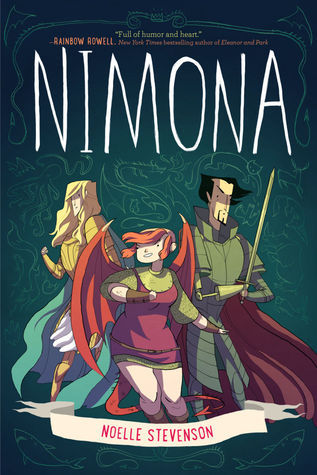
Nimona by Noelle Stevenson
Nimona is an eye-catching graphic novel, adapted from a web-comic. The cover shines with friendly colours and a smooth, warm look and feel. All art is a matter of taste, but when I first saw Nimona in someone's hands, something clicked and I immediately wanted a copy of my own, without knowing anything about the story,
The story starts out with gusto: a villain, Lord Blackheart, is joined by Nimona in his lair. She claims to have been sent by an agency, to be his new sidekick, but he does not believe her... when she finally wins him around and accompanies him on his nefarious crimes, he soon finds her fiercer and more ruthless than he ever imagined - but also oddly adorable.
From the first page to the last, it's full of affection for its characters, which shines through in the art, the characters' facial expressions, the story. Nimona is very child-like, Blackheart, though aloof, is quite gooey inside, and their nemesis is a lot more concerned with his appearance and reputation than with his deeds or his true inner self.
Of course, any story with a villain as its protagonist needs a sense of mischief to work, and Nimona has plenty of that. This isn't like Wicked (the book), pseudo-literary and boring. It's more along the lines of Despicable Me and Megamind, except it doesn't shy away from violence and lethal collateral damage.
As you might guess from a book which lists its selling points on its back as "NEMESES! DRAGONS! SCIENCE! SYMBOLISM!", the tone of the story is light and filled with enthusiasm. It has that slightly quirky tone of a tale written for (or by) young people who grew up with LOLcats, ALL THE FEELS, emojis, animated gifs, SQUEEE, Hyperbole and a Half, internet subcultures, cosplay and an extrovert love of playfulness. It maintains the playfulness and quirky mischief for quite a while, but as the story heads for its big showdown, things get a little more serious.
Personally, I did not love the final act. The tone shifted a little farther than I'd liked towards taking itself seriously. Some aspects did not quite work for me... but for other reviewers, the ending worked well. It's definitely a matter of personal taste.
All in all, a graphic novel I'm happy to recommend. Well worth a read!
Rating: 4.5/5
Subscribe to:
Posts (Atom)