Cairo, a graphic novel by G Willow Wilson, is in love with Egypt and the Middle East. Written a few years before Alif the Unseen, the story predates the Arab Spring, but has similar flavours to Alif's tale. Cairo, too, is a story of jinn and myth, fluidly intermingling with modern life in an Arab city.
The plot of Cairo revolves around an ensemble of (mostly young) characters. A young Californian woman who wants to work for an NGO in Cairo to escape ennui. A drug runner who shuttles between Cairo and Israel & Palestine. His sister, a belly dancer, and his best friend and her fiancee, a column writing journalist. A young Lebanese American on his way to try and do something he thinks would be meaningful. An Israeli special forces soldier who finds herself on the wrong side of the Egyptian border. All their fates become linked through a jinn and the vessel he has been bound to. The jinn, meanwhile, is on a quest of his own, pursued by an evil warlock...
At times, Cairo feels like 'Avengers Assemble' - it's a story of how these very different characters with different objectives find themselves on a road to a shared heroic adventure. There's some sense of humour, but it's quite wry compared to other comic books. What sets Cairo apart from other comics is the setting and the richness of its character detail. This is a graphic novel for grown-ups. That doesn't imply it has sex in it - it doesn't - but it does not talk down to kids and the heroes are distinctly complex people. In many ways, Cairo reminds me of Neil Gaiman's Sandman: it has a similar richness of myth, complexity and people.
If there is a flaw, it's that Cairo is perhaps a little too much in love with the Middle East and with Islam. It offers up a slightly rose-tinted view of the region. The same applied to Alif the Unseen: as a convert to Islam, G Willow Wilson does occasionally allow herself a devout moment. In Cairo, there is one scene that stands out for feeling forced, when a character is given a Qu'ran and his eyes light up with some sort of understanding... That is not the only moment that made me think a writerly cheat / shortcut had been taken, but it was the one that jarred the most.
As a graphic novel, Cairo has a distinct visual style. It's very cinematic, especially in its transitions between scenes, which mimic movie editing. The artwork is lovely (again, reminding me of some Sandman issues), though not as sumptious as the gorgeous (but sadly misogynist & racist) Habibi - which is the highest visual benchmark I have come across for Middle Eastern themed fantasy graphic novels.
I would highly recommend Cairo to readers who enjoy (urban) fantasy and graphic novels.
Rating: 4.5/5
Monday, 23 January 2017
 />
/>

Friday, 20 January 2017
2016: Year of The Deplorables?
I am an inherently political person. This doesn't make me great company - much as I love conversations about a million topics, there is a high chance politics will enter it sooner or later when I'm around. This blog post will be my attempt, in a ruminating, rambling kind of way, to digest the past year (plus or minus a bit).
Saturday, 31 December 2016
Planespotting in Madeira - tips (off-topic post)

Why Madeira?
Madeira has a special place in the heart of European planespotters, not because of the number of planes or the variety of airlines or the proportion of widebodies flying there, all of which are a bit underwhelming. No, it's the airport itself, its location and construction, and, most importantly of all, the more-exciting-than-usual approach and variable winds that make the island a bit of a Mecca for aviation enthusiasts.
Key Attractions
- The island is virtually all mountains and valleys. (The plateaus at the top are national parks and nature preservation areas and unsuitable for airport building). The airport is by the coast, with a runway running alongside the coastline.
- The runway was extended twice. As there was no land to extend it on, the extensions were built on hundreds of 70m-high concrete pillars. Basically, about a third of the airport is built on platform / bridge. Several roads and entertainment facilities are below the runway among the pillars carrying it.
- Planes landing at the airport either do an approach which involves a u-turn into a very short final approach, or they approach in a less dramatic line, but through an area that seems a lot more plagued by gusts and crosswinds. The U-turn approach involves flying towards the mountains, which can be a bit nerve-racking for passengers.
- Planes landing via the u-turn approach can be photographed with the terrain in the background, so you can see houses and gardens and mountainside just behind the plane...
- As the airport is small and space very restrictive, planespotters can also get very close to the runway. Even better, as the land rises away from the airport, you can be close to the runway and above it, looking down on planes landing and taking off, at an angle usually only available to airport towers or helicopters...
- Because of the way the coastline zigs and zags, you can also find locations directly aligned with the runway, and above, from which to take photos of planes approaching and landing. It's not the same as the famous checkerboard hill at the long-closed Hong Kong Kaitak airport, but it's a pretty rare opportunity nonetheless.
- Oh, and Madeira is a stunning, stunning island. The most spectacular in the Atlantic. If you want sand beaches, you'll have to go to the Canaries or to Porto Santo, and if you want calm nature and few tourists, you should visit the Azores. However, if you love mountains, forests, nature, the sea and spectacular scenery, while also appreciating good weather that never gets too hot or too cold, and being tolerant of relatively high tourist numbers, then Madeira is perfect. If I were religious and believed in Eden, I'm pretty sure Madeira would be it. The island also hosts a variety of festivals - apparently, the New Year's fireworks are world class (and were recently in the Guinness Book of World Records for their scale), there are is a huge island-wide flower festival in spring, etc. etc. - basically, Madeira is a world class destination even if you aren't a planespotter.
Below the break, you will find lots of photos to illustrate the points, and a planespotting travel guide.
Monday, 19 December 2016
Review: Planesrunner by Ian McDonald

Planesrunner is a story of parallel universes, and Everett's dad, a quantum physicist working at London Imperial College, was heavily involved in researching these. Soon, Everett goes on a quest to rescue his dad, using just an iPad with an installation of the Infundibulum - the key to the multiverse - to help him on his journey.
The story is engaging from the start but it really hooks its claws into the reader when we meet Sen, a girl who lives and works on an airship in a parallel London. Everett is on a quest, but Sen introduces him to her swashbuckling world filled with its larger-than-life crew, and turns his quest into a joyful, relentless, occasionally piratical adventure. (I'm sure I wasn't the only reader who found the Everness a bit reminiscent of the Firefly...)
Highly recommended: a novel which is smart and superb fun.
Rating: 5/5
Saturday, 3 December 2016
Book Review: The Elusive Elixir by Gigi Pandian
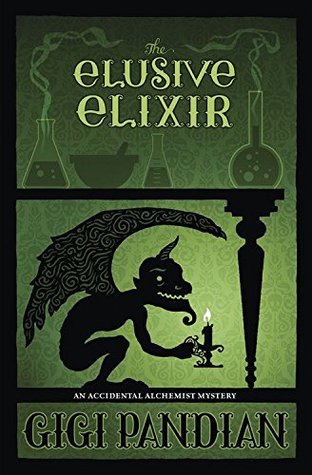
Zoe Faust is the 'accidental' alchemist the series is named after. Having discovered the philosopher's stone, she does not age, and has lived for several hundred years as a young woman. (All alchemists can discover the secret to eternal life, except it is a different one for each and its method cannot be transferred to any other)
In the first book, a living gargoyle, Dorian Robert-Houdin, turned up at her (newly acquired) door and turned her life upside down. Since then, she's discovered that a sinister group of alchemists have been using 'backwards alchemy' and a 'death rotation' to take alchemical shortcuts, which is Evil. Dorian, however, owes his life to it, and as backwards alchemy has started to crumble around the world, so Dorian, too, is rapidly losing life force.
The Elusive Elixir is therefore a book about Zoe's continuing quest to save her friend. The first two books were primarily (murder) mystery novels. The Elusive Elixir, too, is bound to please fans of Jessica Fletcher / Murder, She Wrote, but the urgency of Dorian's deterioration is more in the foreground than before.
The Accidental Alchemist series is pleasantly entertaining fun. Murder, mystery, magic (well, alchemy) and an incorrigible living gargoyle and an equally incorrigible teenager provide plenty of diversion. Meanwhile, as Dorian is a chef by training and Zoe is a vegan, the series is unique in its focus on vegan food, which features heavily. The foody descriptions throughout are plentiful, and each volume includes a bunch of vegan recipes at the end.
The one thing that Gigi Pandian has not quite mastered yet (in my opinion) is the art of exposition. There's quite a lot of it in each novel, mostly delivered by Zoe reminiscing. If you have not read the first book in the series, rest assured, all its plot points are delivered in each subsequent volume by means of slightly clunky exposition To make matters worse, there is an awful lot of repetition. If I didn't know any better, I would think Gigi Pandian is a fairly elderly writer, as it does have a bit of a nattering habit of self-repetition. (She's not elderly, at least not according to the 'About the Author' text in the back). Perhaps the Accidental Alchemist series is aimed at an older reader demographic (like the Brenda & Effie Mysteries series) - for me, it was a bit annoying.
If you like light entertainment murder mysteries, (urban) fantasy and a dash of vegan cuisine, and if you can forgive a little clunky repetition, you'll enjoy this book (and its predecessors) very much.
Rating: 3.5/5
Sunday, 27 November 2016
Book Review: In Calabria by Peter S. Beagle
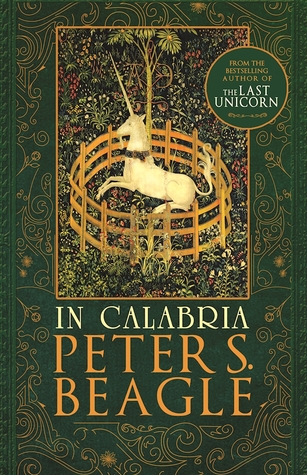
Incidentally, it is about a unicorn. Or rather, it is a novel about the impact a unicorn has when it appears one day in the back yard of a cranky old farmer in the Italian region of Calabria.
Our hero, Claudio Bianchi, is just the right sort of curmudgeon. He grizzles and growls, but without any malice. He's virtually a hermit, content to live at the outermost edge of society, but cares deeply about the animals he tends to. His only regular human contact is the postman, who teasingly asks Claudio about his poetry on a daily basis. Beagle knows how to create authentic reality by zooming in ever so briefly on the minutest, but most human detail, and this gives a richness to the flavour of his stories.
Two things change in Claudio's life: the unicorn appears, and, coincidentally. the postman's younger sister takes over responsibility for delivering the mail on Fridays.
In Calabria is a lovely novel. Even though it is set in the present, it has a strong sense of the Romantic (in the sense of the Romantic period of literature & art) and a yearning for magical beauty. It is also a novel about a curmudgeon slowly softening up, and a novel about defiance against evil. That said, it is not quite as wonderful as the recently published Summerlong: the story has fewer characters to play with, and, though unfathomable, the unicorn does not have the same charisma as Summerlong's Lioness...
Rating: 4/5
Sunday, 20 November 2016
After Atlas by Emma Newman

Anyway.
After Atlas is the story of Carlos Moreno, a hard-nosed far-future homicide detective with a complicated personal history, who is assigned a gruesome case that is intimately interwoven with that history. He's the left-behind son of a woman who was on the interstellar Atlas spaceship that left Earth 40 years ago. He was, briefly, member of a cult that turned its back on the internet and technology. And, after fleeing from the cult, he became a refugee and ultimately a slave.
Stories don't get much more noir than After Atlas. Not only is our (enslaved) gumshoe a cynical lone wolf, not only is the locked room mystery grim and brutal, but the world is cruel and unforgiving, and the grotesquely gory case is just a bloody symptom of a larger, deeper corruption in the world.
After Atlas is very different from Planetfall. Where Planetfall is dominated by its psychological angles (tackling mental illness in a character trying to colonise a planet), After Atlas is much more conventional. There is a tangential element of mental health stuff going on (Carlos uses meditative practice to ground himself when he gets into situations he struggles to cope with), but for the first half of the book, solving the crime is really the be-all and end-all of the story. The second half - well, let's say that the story simultaneously widens out and narrows down in very unexpected ways.
What it does have in common with Planetfall is that this is not a feel-good novel. It's an intelligent, well-written and tense one, but it puts you through the wringer. Ultimately, its view of humanity and society is much more bleak than that of even the grimmest film noir. Worth a read, but be prepared for a tough time.
Rating: 3.5/5
Subscribe to:
Posts (Atom)