Sunday, 13 October 2013

The Republic of Thieves by Scott Lynch

The Republic of Thieves is very much the story of Locke Lamora and Sabetha. In the first two Gentlemen Bastards novels, Sabetha is a name which is mentioned, a presence without ever making an appearance. It is the sort of foreshadowing that means her actual entrance has to be quite impressive to live up to all the anticipation. I'm happy to report that it does, and then some.

Locke (our whip-smart but short & weak hero) and Jean (his big strong bestest buddy friend) start the novel holed up in a city: Locke has been poisoned and is slowly internally bleeding to death. Jean means to save him. Things look bleak, and it takes quite a good chunk of text before the real story starts. So, the beginning of Republic of Thieves took some effort. It also felt unusually grim and a bit slow. Once the story moves, Jean and Locke are tasked with arranging an election victory, and find out that their opposition has hired Sabetha to do the same.

The story is told in two intersecting paths - Locke and Sabetha in adulthood, and then, intersecting with that, their childhoods / young adulthoods. The parallel narratives work so well, I can barely imagine the novel being told any other way. Once Locke and Jean are recruited into their task and arrive to start work, the pace just never slackens at all. The novel becomes a stunningly enjoyable, exciting and quite playful tale.

In fact, playfulness is at the very heart of the novel: if romantic tales were generally this playfully fun, I think I could be converted to read more of them. And the novel even contains large chunks of a perfectly authentic sounding (to my ears) Shakespeare-style play: hats off to Scott Lynch for carrying that one off.

What makes Republic of Thieves stand out is that it feels like the writer is conscious, perhaps too much so, of the shortcomings /criticisms of... well, pretty much every other fantasy novel featuring female characters, and pretty much every other tale pitching a male lead to compete with a female one while romantic entanglements ensue. It's as if someone really intelligent had sat down, thought hard about gender issues in fiction and genre tropes, noticed all the flaws in boy vs girl stories (Mr and Mrs Smith, That Girl Friday, etc etc), and then decided to write a sensitive, well-planned, post-postmodern, positive-about-women-gay-people-and-everyone response.

In short, sometimes Locke's & Sabetha's interactions feel just a smidgen too utopian. Sure, they run into problems. But then they talk about things, and do so frankly, honestly and with insights into themselves (and each other). They have feelings and irrational moments but can step back and express themselves coherently and discuss them and deal with stuff. Also, Sabetha is intelligent, strong, uber-competent, and without any discernible weakness or flaw: she is written to be the perfect woman. When it comes to Locke, Sabetha and Jean, they're all just a bit too perfect and wise and eloquent, and too self-analytical and communicative.

As flaws go, that is a minor one. But it did make me wonder whether the previous novels already had such worthy philosophies underneath. I do have some memories of female characters (a pirate captain, and, after much racking of brains, an underworld princess), but none which left quite as lasting an impression, nor do I remember there being nearly as much 'talking things through' in those books. But then, it's been years since I read them.

Anyhow, a lot of my commentary above is not so much about the book as analysis of themes in the book. There are two simple reasons: I don't want to give much away, and I'd be left exclaiming one superlative adjective after another: the book is just too much fun, so I'd end up calling it "great" and "fantastic" and "delightful" and "terrifically enjoyable" and other similar things, which sounds all too fluffy.

(However, like the preceding novels, Republic of Thieves does not end with an unmitigated happy ending, and does leave off with an opening for the next in the series).

If you've read the other two, get this one and read it NOW. If not, get the other two first, read them, and THEN read this one. (Without reading the others first, this one will probably struggle to stand on its own) This book alone is worth reading The Lies of Locke Lamora and Red Seas Under Red Skies for, just to have the pleasure of reading The Republic of Thieves.

Rating: 5/5

Tuesday, 8 October 2013

An Instance of the Fingerpost by Iain Pears

I wish I remember how I came to buy An Instance of the Fingerpost- I have a vague suspicion it might have been an Amazon recommendation, but I am not entirely sure.

At any rate: I bought it. I read it soon after buying it. I found it incredibly rewarding and enjoyable to read - one of the best books I've read, even though much of it went over my head.

An Instance of the Fingerpost is a historical novel. Many - indeed, most - of the characters are historical figures. Some of the key characters are fictitious, or heavily fictionalised versions of real people. And the events in the book are using history as a springboard rather than a millstone - much of the plot at the heart of the novel is entirely imaginative, rather than factual.

The book comprises of four narratives, one after the other. Each narrative recalls the same period of time, in Oxford, when a series of events happened which left their mark on all the narrators. The first story is that of a man called Marco da Cola, a rich merchant's son from Venice, in England to look after business interests and try his hand at experimentation and discovery. Drawn into the lives of an elderly woman and her daughter by accident, he tries to act as a physician for the (badly injured) old woman, and, in the course of his story, does an experiment which he wishes to regain credit for - because, through betrayal, his role has been written out of history. And then there is a suspicious death, and the plot thickens...

The second and third narratives are written by much more sinister men, with evil deeds they admit to (and suspicions about others). Each reveals a new layer of the events covered in the first. The final narrative tries to pull it all together, and present a new picture entirely...

Each of the narrators is unreliable. Each, of course, thinks he has the monopoly on truth, righteousness and rightness. And each fills in the gaps of things he does not know with assumptions, guesses and suspicions. The second and third narratives are positively dripping with paranoia an venom. The first is comparatively more jolly, and the final one more keen on facts and less keen on interpolation. That said, the final narrative is by far the most... fantastical, shall we say?

The writing is masterful, in my opinion. The tone is perfectly plausible and authentic enough to give the story atmosphere, without being slavish to 16th century language. There is significant wit and a very dry, dark sense of humour in the telling of this tale, made all the more delightful because none of the characters are being intentionally funny - they merely have conversations and make observations which a 21st century reader would be very very amused by, while being perfectly earnest. Punchlines are never delivered at the end of a sentence or paragraph, but in the middle of the flow of the dialogue or narrative, and so the overall effect is much more witty, in my opinion.

In terms of historical characters, I confess to knowing next to nothing about all of them. I have a very vague inkling of Cromwell, but no real understanding of that period (or any period) of English history. The religious jostling is perfectly beyond me: I have no idea even today what the big differences between Christian denominations are. Oh, I know Anglicanism was founded to permit divorce, and Evangelism / Protestantism a backlash against the centralised Catholic church, and I know there are some differences (confession, Lent, yadda yadda yadda), but to me as an outsider, it is inconceivable that all these minor details would matter in the least. So when the narrative speaks of Catholics, papists (the same, I gather), Anglicans, Protestants, Jesuits, Methodists, Quakers, etc. etc. etc. - I simply do not understand the religious differences, nor do I always follow the historical import of any particular faction's actions / conspiracies. That is probably why the second and third narrative are less engaging than the first - these are the big political sections. The first and last are much more focused on a life-or-death drama about individual characters that earn the reader's compassion, empathy and care. The second and third narratives, while involving individual struggles, are much more about blinded, furious men with bitter hearts, hot obsessions but coldness where any notion of compassion might be...

Much as I loved the writing, and the authentic detail, there were bits when I skim-read and got a little bored. Each narrator spends time swearing his honesty and trying to win over the reader to his view of events, and the wheedling, authentic as it may be, grates. Similarly, sometimes characters would start philosophising about stuff which matters little to me / the reader, and those sections, too, can tire. The constant one-upmanship of using quotes from the Bible between different characters is diverting and amusing at first, but by the end, you sort of want all of them to think a little more about the world and a little less about which quote is the most useful riposte...

Even though I did not always understand every nuance, I believe I understood most of the plot. The number of characters was so staggering I often lost track of which named person was suspected of which deed in which conspiracy, but I think that did not detract too much from the tale, for the paranoid bits are a bit frantic in their suspicions anyway. The real heavy lifting, in terms of reader engagement, are done by the first and the final narrative, and I will admit, the first left me with a night of very poor sleep as its conclusion was quite harrowing. The final narrative and the way the story is pulled together is ... definitely elegant, and pleasant to read, but also quite difficult to reconcile with this particular reader's willingness to suspend disbelief. I guess I can just assume that our final narrator, too, is unreliable - as unreliable as all the others, and merely presented as the most convincing because his is the final account, and because he is able to address things mentioned in the other three narratives and put the final word to it.

I would certainly count this as a masterfully written novel, and a masterfully executed concept / idea, and one of the best novels I have read. I found it very rewarding, even if not all aspects appealed to my own sensibilities.

Rating: 5/5

Friday, 6 September 2013

The People in the Trees by Hanya Yanagihara

Looking back, I wonder why I pre-ordered The People in the Trees. I guess the marketing blurb must have worked. I like to think that I can be enthused about "challenging and visionary literary fiction", that an "astonishingly gripping and accomplished first novel" would excite me, that "an anthropological adventure story that combines the visceral allure of a thriller with a profound and tragic vision of what happens when cultures collide" would be the sort of book I could enjoy.

Alas.

Part of the problem is the way all the major plot points are revealed in advance. If you read the blurb and the prologue / preface / start of the framing of the story, you will know every significant story development before the first bit of narrative starts. That is not the way of thrillers, and it is not the best way to tell of adventures. (Some adventure stories do give you a gist in advance - but they leave enough details for the main story to thrill you with. This book does not leave such room for excitement: it really does give you everything that's interesting in advance)

So, forget about narrative tension, forget about wanting to find out what happens next: you already know what happens next, pretty much all the way to the final page.

Fine. It must be the writing voice, then, which bewitches and seduces you, takes you away from your own life and into another. Right?

Well, our narrator is a scientist. He's a callous, hard-to-like, arrogant and judgemental man. But his tone of voice is matter-of-fact and the reading experience is roughly comparable to reading a very long Wikipedia article. (A summary at the start, and then fact upon fact upon fact). Don't get me wrong: there is craftsmanship involved in creating an authentic-sounding piece that could have been written by a scientist, and the writer of this novel has achieved a well-crafted, authentic-sounding work. It just isn't all that enjoyable as a reading experience.

Our protagonist, meanwhile, is exactly the sort of scientist that non-scientist creative types like to imagine. He's judgemental and arrogant, but without actual merit - his Nobel Prize winning discoveries are through pure luck rather than skill. In fact, his skill at science is very mediocre and he is not very academically gifted. He's dedicated to logic and thinking and sense, but unable to understand himself. He's callous, a force of devastation and faintly sadistic: early on, he describes working in a laboratory, on experiments he does not understand, as lowly undergrad doing menial tasks. Of these tasks, it is killing the mice which he enjoys most - flinging them in circles by their tails until they are dazed, then breaking their necks with his hands - and he describes, with some glee, how he used to kill them in bulk by swirling many mice simultaneously. It's the sort of nonsense that breaks the suspension of disbelief - not because I cannot believe in casually sadistic men, but because I don't think that this method of killing mice would be particularly popular, nor even that it would be particularly easy to accomplish. It simply reads like a fantasy of someone who distrusts, resents and secretly envies scientists.

Despite its lack of enjoyable qualities, the novel is a detailed character study. Much of it feels authentic, and the number of scenes when authenticity is missing entirely are fairly limited. (Of course, these scenes revolve around the medical mystery, and the 'science' inside the novel is ludicrous beyond belief)

So, writing of decent craftsmanship, lots of detail, some authenticity, but no joy, no thrills, not much adventure - and nothing particularly visionary or thought-provoking. This is not the novel I expected from the blurb, and it is not a novel I would recommend.

(For some reason, the entire book kept putting me in the same mood as The Testament of Gideon Mack, so if you like Gideon Mack, then chances are, you may also appreciate this novel. It might also appeal to fans of Measuring the World)

Rating: 3/5

Friday, 16 August 2013

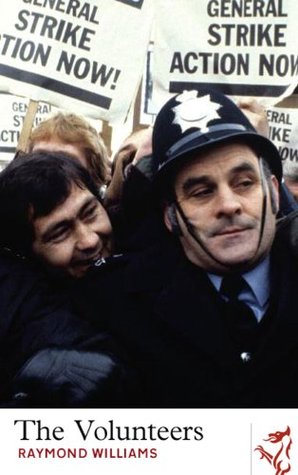
The Volunteers by Raymond Williams

The Volunteers starts with a bit of a bang - the shooting of a politician in St Fagans National History Museum near Cardiff. Our narrator, a journalist working for a fictional equivalent of Newscorp / BSkyB, is sent out to follow the story. He's chosen because he has a past as left wing agitator / protestor, and because, as an ex-insider with some street cred, he might be able to connect with violent left-wingers.

The rest of the novel follows him as he comes up with theories about the events, and stumbles into something which may be a larger conspiracy.

It sounds like a political thriller, and it really very much wants to be. But, with a ruminating writing voice, a tendency to meander, and long descriptions, the story does not read like a thriller.

As things develop, you get a sense of the weaknesses of the book. The author has no good ear for dialogue. Most interactions our reporter has with people are described in some detail - we get descriptions and analysis of verbal manoeuvrings that read a little bit like a sporting commentary, a sort of tactical analysis, each dialogue a little skirmish, but at the same time, a lot of the dialogue is opaque and about not speaking plainly. Often, as a reader, I think I know what people are being circumspect about, but sometimes, I don't. It makes for an odd experience - getting a blow-by-blow tactical analysis without always being sure what was actually being talked about or implied.

The central premise, meanwhile, is just too laden with wishful thinking. It's a novel that is painfully aware of the ineffectiveness of the fringes of political classes at effecting change, so it dreams of mastermind tacticians and grand plans.

The book kept me engaged and interested all the way through, but by the end, it was hard to feel invested in any characters. Everyone was so clearly an idea, a concept, a theory, rather than a human being, that I did not really believe in any of them, and did not much care about any outcomes.

It is not surprising the book was written by an academic - it does have a very aloof feel to it, when it does not go into a journalistic, blow-by-blow account of a serious event. Those bits are quite well-done, but the meat and bones of the novel are rather less well-cooked than the set-piece scenes.

That said, I loved reading a book set in places I recognised (St Fagans! Cardiff! London! Finsbury Park!) and infused with political people and a political Welsh identity that is not just about being Welsh for the sake of being Welsh, but about class war, Unions, communities and industrial conflict (interestingly, without a persecution complex, unlike the grand lament of victimhood that is Cwmardy) - a national identity that seemingly perished a generation ago, by now replaced by a fairly shallow, red-rugby-shirt-wearing hangup about "not being English", with no other distinctions, a sort of boil-in-the-bag cultural identity... as someone who wasn't around in the 80s and who lives in Wales now, reading about a very different Wales was quite interesting.

As a novel, it's certainly a lot more fun to read than Cwmardy.

Rating: 3.5/5

Monday, 12 August 2013

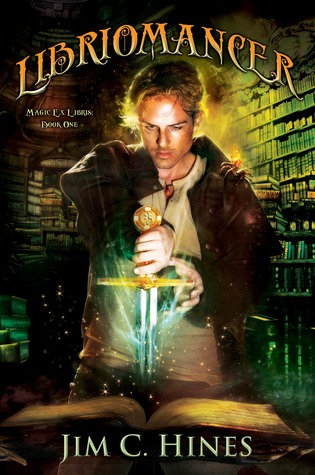
Libriomancer by Jim C. Hines

Libriomancer starts out at a galloping pace and never really takes a breather. Fire spider, library, VAMPIRE ATTACK, rescue, GANDALF HAS DISAPPEARED, WAR IS ABOUT TO START, RUN RUN RUN RUN RUN RUN.

(I say Gandalf. I should say Gutenberg).

The writing is decent, the pacing solid, but somehow the story never really bewitched me, it never lulled me into that magical sense of being totally engrossed. It never absorbed me in the way that great fiction does. It's not The Neverending Story, it's not Inkheart, and it took the book about 150 pages before I actually started to like our hero. It's not that he is anything less than a decent guy, it's just that he isn't anything more interesting than your average guy either (until he finally unleashes some librarian-powers and starts doing detective work through means of research). Basically, everything is done well enough to be solid B-rate fantasy.

I suppose one of the big factors in not quite making me happy is the central conceit: that books are magical and magicians can pull things out of books, but the things have to fit through the space of the book's pages, and not be living intelligent beings. Which sounds interesting enough, except mostly, our hero pulls out guns or swords or, at a stretch, healing potions. It reads like books are a storage system for weapons and potions in a video game. It's a very utilitarian approach to "the magic of reading", and quite disappointing. (Later in the book, things get more interesting, but it takes about half the novel before things start to intrigue at all).

It's readable, well-paced light entertainment. Not terribly absorbing, but pleasant enough.

Rating: 3/5

Friday, 26 July 2013

Cinnamon and Gunpowder by Eli Brown

Cinnamon and Gunpowder is a novel about a chef who is kidnapped by a female pirate captain, forced to become her personal chef cooking a nice meal for her once a week, while she continues her obsessive pursuit of a mysterious individual and a vendetta against an evil corporation.

The writing is authentic enough, feeling similar to Mary Shelley's Frankenstein in tone. That also means it is not necessarily very lively: Victorian writing tends to be quite wordy and not very streamlined. Just like Doctor Frankenstein, our hero is a rather whiny fellow. The story is told in diary entries, so many chapters start with a breathless "I can't believe I just survived these perils" type sentence - which tells you that he survives and that there is little need to worry or fear for our narrator's safety.

The most notable thing about the story is that it reads like a complete gender inversion of a typical Stockholm Syndrome pirate romance tale. Dominant captain kidnaps verbally spirited, but physically weak and generally unwise person. Kidnap-ee plans their escape, verbally opposes the captain (by whinging, mostly), occasionally gets up to some mischief causing themselves problems and a bit of havoc on board, but is ultimately exempt from the ship's otherwise harsh discipline because the captain has a weak spot and keeps the weakling under their personal protection. Over time, the weak kidnap-ee develops feelings of loyalty and devotion towards the strong, dominant captain. Except this time, the weak kidnap-ee is a man, and the dominant captain is a beautiful red-haired woman. It's Mills and Boon, only backwards.

I like the idea, but I found that it was often unconvincing: male leads are supposed to be protective of female protagonists. That's chivalry. When it's reversed, it is an inexplicable and alien favouritism that seems unconvincing and a bit wrong. Also, a female kidnap-ee on a ship full of men stands out because she is female (rendering her in more need of protection). A male kidnap-ee on a ship of men does not stand out and does not seem to warrant extra patience. Basically, it turns out a complete gender reversal just feels strange, forced, and unconvincing, even borderline unpleasant. Perhaps the dominant-character-kidnapping-weakling and weakling-falling-for-their-abductor plotline is a bit toxic, no matter what the gender assignments are.

There is more to the plot - it also deals with the Opium Trade and British Imperialism etc. - so there's something quite educational about the story. The steam-punky obsessive captain in pursuit, with hot air balloons, rockets and crank-powered machine guns, on the other hand, seems much less authentic.

In terms of swashbuckling adventures, there's plenty. Some beggar belief (a person survives without boat in the ocean for two days and is then, through dumb luck, picked up by another ship, which happens to be a very important ship to the plot...), but for the most part, the adventures are on a grand scale and just this side of believable.

All in all, it's not a bad novel. It's just not very good, either...

Rating: 2/5

Saturday, 20 April 2013

In Great Waters by Kit Whitfield

In Great Waters is a speculative fiction novel set in an alternative Britain where merpeople (known as deepsmen) are real. They are not really like humans: fiercer, more direct, more blunt, essentially, very intelligent animals. Related to dolphins, they are not unlike chimpanzees in personalities. They can interbreed with humans (which results physical and mental differences). And thus we meet Henry, or rather, Whistle, a crossbreed who is born in the sea and ultimately grows up among humans on land.

I don't want to give too much away. This is a novel where great care is taken: the world building is immersive yet gradual. It's detailed and carried out with great writerly craftsmanship.

Tension - and plot - builds up very gradually. The reader gets to absorb this world, become a part of it, and understand it (and its characters) before the story starts gaining momentum. In a way, the book gives you a chance to experience intrigue at the settings and characters, before the plot becomes intriguing, and once the plot starts creating tension and pace, it turns genuinely thrilling, with several twists and turns that are authentic and not too far-fetched. And giving away too much of the setting and plot, to me, would detract from the reading experience. What I would say is that, if you can persevere through the gradual start, the book is very rewarding.

There are some big events, about three quarters of the way into the book, and after that the big central plot tension is partially relieved, yet the story continues, tidying up plotlines (with a few more tense episodes). I do feel that the book allowed itself a somewhat more gradual ending than most readers will be used to, and perhaps it could have been somewhat shorter.

However, the imagination and craftsmanship is stunning and truly immersive. The book actually made me think about some things with a different perspective (royalness and bloodlines are an important part of the book, and, once you accept the central conceit, you start to look at our own world with new eyes, and may find our own world more baffling and illogical than the one in this novel). And last but not least, it is a thrilling novel, with large sections of page-turning pace and tension.

I would absolutely recommend this novel, and I don't think I've read anything quite like it. Glad I stumbled across a review of the book by Jo Walton (author of Among Others): In Great Waters deserves a lot more attention.