Saturday, 12 July 2014

Three Graves Full by Jamie Mason

Three Graves Full is a novel that really wants to be a comedy movie. Jason, our protagonist, is a meek man who, in a rare fit of rage, has murdered someone and buried him in his back yard. A year later, someone discovers a skeleton - in his front yard.

The book continues the tale of hapless Jason, and adds various other characters (the ex-girlfriend of one of the victims, two police officers, a dog...), and creates a web of unlikely events that have the general feel of a Guy Ritchie movie (or perhaps an indie movie) - except it's all set in America.

It's a pleasantly diverting, vaguely entertaining yarn, marred by being somewhat overwritten. The writer seems to be a beginner - the prose itself is frequently clunky and over-reaching, but there's also a tendency to give detailed back stories of each character and event, often filling in details that weren't really needed. It's also a book that yearned to be laugh-out-loud funny, but wasn't.

A promising premise, not quite lived up to.

Rating: 3/5

Wednesday, 9 July 2014

Eight Men and a Duck by Nick Thorpe

In the non-fiction book Eight Men and a Duck, a journalist has a chance encounter with a confident, gung-ho adventurous American, and decides to join the American's quest to cross from Chile to Easter Island in a reed boat, inspired by Thor Heyerdahl's Kon-Tiki adventure (which never actually landed on Easter Island).


The book reads like someone telling a yarn to his mates. It's chummy, everyone's improvising, a bit inept, and hugely reliant on luck. The quest is about as wise, responsible and well-prepared as the adventures in the Hangover movie series, but there's less humour.

It's not really a scientific thing: it's people having an adventure for adventure's sake.

Once the only vaguely skilled person left the team (frustrated with his companions' habit of winging it and lack of preparation / forethought, and the resulting delays), the narrative lost a lot of interest for me. Basically, I didn't really like any of these guys all that much, as I could not respect them.

It's not a bad book, but it doesn't really have anything much to say: A bunch of bumbling young men seek adventure and succeed mostly through luck. The end.

Rating: 3/5

Saturday, 5 July 2014

Seed to Harvest by Octavia E. Butler

Seed to Harvest is a series of four novels, collected together in one volume. The third book is essentially a standalone novel, while the fourth ties it and the first two books together.

The novels start with the meeting of two virtually immortal people, a long time ago (18th century, I think) in Africa. One is Doro, a man whose soul travels into other bodies (and whose previous host bodies die / are discarded). The other is Anyanwu, a woman who has near-infinite abilities to heal her own body, and read her own DNA, understand what each cell is doing, and how to heal / regenerate / rejuvenate herself. Doro is much older - thousands of years older - and has been breeding people with supernatural powers into little (quite incestuous) communities in order to cultivate their supernatural traits. He decides to conquer and control Anyanwu, and the first novel is essentially about the relationship between them.

The second novel, set in the 1970s or so, is about a young woman who is the most powerful result of Doro's breeding programme, and who becomes a power to contend with.

The third novel is about an invasion by an alien parasitical micro-organism which changes the physical properties of the humans it infects, and permanently alters their offspring.

The fourth novel is about people from the breeding programme, and their power struggles, while in a world-wide war with the people who are infected with the alien organism. Humans without superpowers have become nothing more than slaves.

Reading these novels, it becomes very clear what themes interest Octavia E. Butler: power, control over others, the mechanisms of slavery. Every single one of the books is about people imposing their own will and control on others, with motives that range from mean-spirited and petty to survival instinct, from lust for power to a desire to protect humanity or protect family. In essence, these are all novels about enslavers and the enslaved.

Unfortunately, the novels aren't nearly as gripping and powerful as Kindred (by the same author), which doesn't bother to metaphorise slavery into supernatural fantasy, but simply transposes a modern couple into the past through time travel. Kindred is a masterpiece. Seed to Harvest is comparatively weaker, because none of the characters are entirely human. Super-powered people using super-powers to enslave are less scary than men using mundane brutality. The fantasy elements create a distance between subject matter and impact on (this) reader's empathy.

I must also admit that I did not really find Anyanwu's character convincingly developed after the first book - I think her story in the second book was wasteful and disappointing.

I'd still recommend the author highly - but I'm really glad I read Kindred first: it's a much, much better novel than this series.

Rating: 3/5

Friday, 4 July 2014

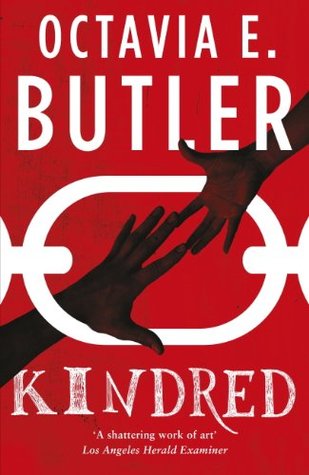
Kindred by Octavia E. Butler

I don't usually read any books set in the world of US slavery - Uncle Tom's Cabin was just about the extent of my reading thus far. But then, Kindred isn't a typical slavey novel.

Dana is a 26-year-old woman living in 1976. She's recently married to a white man. And one day, she gets dizzy and finds herself elsewhere, watching a little boy almost-drown. She saves his life, realises she is visiting the slavery-era past and gets beamed back to 1976. Soon, the rules of her travels become transparent: whenever the boy is about to die, she is transported across space and time to save his bacon. Whenever she fears for her life in that world, she is returned to 1976.

The plot follows the logic of the story consistently, intelligently and entertainingly. The characters all seem believable. It's not challenging to read, but intelligently written with a lot of thought about what slavery is, how it works, how it changes people - both the slaves and the slave owners. It feels completely authentic and believable all the way through. It's a novel about power relationships and how power corrupts. The story is tense and gripping and smart.

In short, I'd highly recommend this book.

Rating: 5/5

Wednesday, 11 June 2014

The Rook by Daniel O'Malley

Starting out with a whopper of a premise (person wakes up without memories, surrounded by dead bodies, and has instructions from her own former self about what to do), The Rook is a novel that's not afraid to entertain.

A tongue-in-cheek tone, plenty of action scenes, and a world full of superpowers, secret organisations, hijinx and adventures. It's very light reading, thin on worthiness, big themes, and even characterisation. (Even by the end of the book, many of the characters and names seemed quite interchangeable to me).

It's not even very good at convincing anyone of its setting: it may nominally take place in London (and the rest of Britain), but it never feels as if the author has actually set foot in the city (or the island). The plot has a tendency to get a little lost among big setpiece action scenes, and some of the side plots are pure distractions with little purpose.

It reads like a comic book / action movie.

But it also reads like fun. A damn big shedload of fun. I'd recommend it for a light-hearted diversion.

Rating: 4/5

Sunday, 1 June 2014

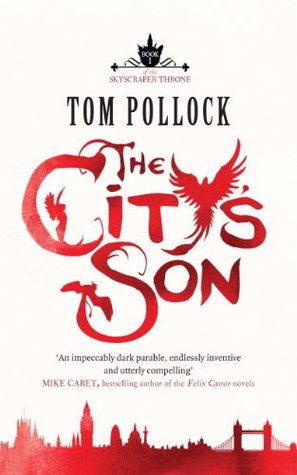
The City's Son by Tom Pollock

The City's Son is a young adult urban fantasy novel set in London. Its main characters are Beth, a streetsmart girl, and Filius, the son of the absent goddess of the city. After being kicked out of school, Beth seeks out her usual hide-out, an abandoned railway line. She encounters a ghostly train, after which she finds herself in other-London, Un-Lun-Dun, Neverwhere-London, the city inside the city, where spirits roam, statues are alive, scaffolds are scaffwolves, streetlamps have personalities and tribes...

It starts out pacey and keeps up a decent pace throughout, as Filius takes Beth along, wandering from tribe to tribe to try to gather their support for an upcoming war against his mother's nemesis, Reach. There's plenty of action - too much action, in fact, with confrontations and scenes that take several pages to go through just a few seconds of fight. I tend to find blow-by-blow accounts distracting / disruptive to pace, so I sometimes skimmed a little.

The story is quite entertaining and the world interesting enough. This is urban fantasy closer to Neverwhere, Kraken and Un-Lun-Dun in atmosphere: it's not really London at all, but a fantasy world which simply shares some of the place names and some of the aesthetic. (Of all the urban fantasies in London, only Ben Aaranovitch's Peter Grant series does it masterfully, interweaving the different worlds in a way which stays just on the right side of believable)

One of the things which I found quite pleasing at the start is that one of the side characters, Pen, is a Muslim teenage girl, who's basically just a regular teenager with a somewhat more conservative family. There are not enough characters like her in novels - or at least, not enough of them in novels that are about something else.

On the other hand, the novel had some aspects which I found uncomfortable. Aside from the many characters who die (or, worse, are permanently mutilated in some way), there is a rape sub plot. That did not feel right at all, to have a minor sub plot about sexual abuse and rape, treated with little seriousness and more or less a shrug... then I started wondering whether it might not be a bad thing to handle rape that way in a novel. If rape is very common, and if (real world) victims have to find ways to cope and get over it, does it help if it's always a person-defining horror in stories? Should it just be something that happens to fictional characters before they shrug and move on? I don't know - it still feels somehow insensitive / blase to just throw it into a light entertainment urban fantasy tale for teenagers.

I think it's likely I'll buy the next book in the series, but I find myself hoping it'll churn through fewer characters and be a bit less brutal: this book treated its world with affection and its characters with a cheesegrater.

Rating: 3.5/5

Monday, 5 May 2014

The Rabbit Back Literature Society by Pasi Ilmari Jääskeläinen

The Rabbit Back Literature Society is a book that starts out promising... and then fizzles, gets lost, and dies.

The setup is promising: a writer of mythology-inspired books (mostly read by children) started a small creative writing group for talented kids, a generation ago. She recruited nine children, all of whom have become successful authors in adulthood. Now, decades later, a young substitute teacher (our protagonist) finds herself invited to join the mysterious society as the tenth member.

Oh, and there is a strange plague affecting books in the library: the texts and plots change.

Soon after joining the society (which includes a pivotal moment of mystery), our protagonist learns of 'the nosferatu game', wherein the writers sneak up on each other at night, and challenge each other, and have to tell the whole, unvarnished truth about whatever they are asked (under torture if they lie or omit anything), and then switch around and interview their challenger.

Once she's in the society, the novel quickly loses any kind of momentum and mystification: it mostly consists of interviews via the above-mentioned Nosferatu Game, and dream sequences. The interviews are basically giant infodumps, each character narrating some events and memories.

The reading experience changes during the story: at the start, there are witty, quirky observations, and the sort of clever things a young person might think and be very pleased with. There is a bit of mystery, around the book plague, and quirky mythical magicalness. But that gets lost, as the focus shifts entirely, and then the plot pursues the new focus in a meandering, half-bored way. By the end of the book, I found myself struggling to keep reading, and when I reached a series of chapter called "Epilogue", I was surprised: the story had not ended, and the final chapters were no epilogue, but simply final chapters. Many things never get resolved, and the constant dream-scenes and quite boring expositionary infodumps make the book a painful, boring read.

It starts out reading like the work of a talented writing student (all the characters are writers and aspiring writers and literature students), and ends up reading like something that never knew where it was going and got finished off in an all nighter by someone terribly bored with their own work.

All in all, I'd give this one a miss.

Rating: 2/5