Monday, 9 March 2015

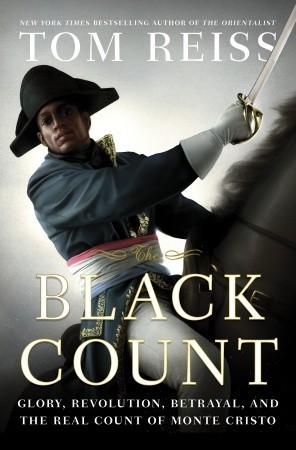
The Black Count by Tom Reiss

The Black Count tells the story of Alex Dumas, father of Alexandre Dumas the novelist (and grandfather of Alexandre Dumas the playwright). He is the forgotten Dumas. In France, they call his son "Alexandre Dumas, pere" and his grandson "Alexandre Dumas, fils" and hardly anyone anywhere recalls the man who first created the name and launched the legacy. Until this book was published, Alex Dumas had more or less disappeared from public consciousness, despite achievements and adventures that inspired much of his son's most successful literary output.

Alex Dumas was the son of a French nobleman and a slave woman, born on a Caribbean sugar island. His father was not the hard-working, entrepreneurial kind, but a freeloader living on his own parents' purse, then his brother's, ultimately being driven away after several years of making a nuisance of himself. When, years later, his father returned to France to reclaim an inheritance that had passed to others (as he was assumed dead after his expulsion & flight), he sold Alex Dumas into slavery in order to finance his own journey. "Sold" is perhaps a strong term. More like "pawned" - Alex was brought to France some months later and reclaimed / the pawning fee was paid off. Even so. He was pawned into slavery so his father could afford passage across the oceans. This speaks volumes of his father's nurturing attitude. (He was the favourite son. His brothers and sisters were sold into slavery outright, if my memory serves me right: it's been a month since I read the book)

From such an inauspicious background, he developed into a swashbuckling hero, a formidable warrior, a general who would lead entire armies, and a major figure on the military side of the French Revolution. He managed to achieve tasks where others failed and even got through the Terrors (the phase of the revolution when so many lost their heads as a result of witch hunts and paranoia about traitors), despite the fact that he was black and despite the fact that early in his career, he had been at interventions where the army - including himself - suppressed revolutionary riots.

He achieved all that despite being black, in Western Europe, at a time when black people were not even considered real human beings in the Christian-run empires and nations. He wasn't entirely without advantage: his father's wealth afforded him a good start in society in Paris before he abandoned all that to join the army. To his credit, he did join the army at the bottom and worked his way up through merit. As the son of a noble, he could have started at an officer's rank.

Ultimately, his career (and life) was cut short not through any personal failure, but as a result of his success: he was more impressive than Napoleon, and Napoleon could not stand him.

The Black Count is the story of Alex Dumas, but it is also the story of a tumultous time in French and European history. In fact, while Dumas' impressive achievements will probably stay a nice little anecdote in my memory, it is the book's progress through a time when solid history turned into quicksand, when ideas and notions and idealism and paranoia got to briefly rule the world, that will stay in my memory longer. That sense of instability resonates all the more strongly when looking at the Arab Spring and its aftermath. Compared to those two revolutions, the fall of the Soviet Empire seems strangely orderly, and the slow rise of Naputinon almost benign in scope. Revolutions, it turns out, tend to lead to years and sometimes decades of uncertainty and hard, messy work, before things settle into some kind of stability.

Napoleon, meanwhile, comes across as a complete weasel in this book. I had not really encountered this Anglocentric perspective in lengthy fiction before. Oh, I know, he tends to be a figure of some ridicule in movies, but since I was taught history in Germany, the general impression of Napoleon imparted to me by school education was very different in character. This book begrudgingly talks of infuriating inconsistencies in Napoleon's legacy, with the Napoleonic code adopted through much of Western Europe mentioned as a positive side effect. Perhaps understandably, German history lessons tended to have a different emphasis, with Napoleon drawn as a flawed tyrant, but one who achieved much and left a stamp on the world that lasts to this day. (Most European nations have legal systems that are built on refinements of the ones Napoleon first put in place. Britain may be built on the Magna Carta, and America is built on the Constitution, but Europe is built on the Napoleonic code)

Aside from revolutions in general, the rights of black people and slaves are of course central to the book. It turns out that, for just a few years during the French revolution, France was perhaps the most equal place in the world in terms of the rights and opportunities afforded to black people, and Alex Dumas just happened to live and thrive in the Golden Age of opportunity. There were even attempts to abolish slavery in the colonies - though those were not acted upon by the governors over there, as the sugar industry was considered too important. Under Napoleon, racism and xenophobic policies were gradually reintroduced, until they were stricter and more prejudicial than they'd ever been. Had Alex Dumas been born a generation later, he would never have been allowed into France, no matter who his father was. Had he been ten years earlier or later, he would never have been able to achieve the things he did.

With a swashbuckling, heroic subject, I expected the book to be a little more exciting than it turned out to be. I expected more -tainment from my edutainment.  However, the book's structure does not allow for the build-up of tension. Even when Alex Dumas is captured and imprisoned and deadly ill, you know he will get through this because the book starts with his death, in France, while his son is having a nightmare, and because his entire career has been outlined in broad strokes at the start. Historic faction always has to battle the problem that readers might already know how everything ended. Even so, the best historic novels manage to squeeze tension and excitement and thrills from readers. The gold standard that I use for tense historical factual novels is Nathaniel Philbrick's In The Heart Of The Sea: I fear The Black Count falls somewhat short of that: I wish it had given less away at the start and made more of the periods of uncertainty. On the educational side of things, however, it is excellent, and it has a lot of interesting knowledge to impart.

Rating: 3.5/5


Cardiff SFF Book Club - April and Beyond!

So we had another small get-together on Sunday to chat about Lock In again - and it was great.

This time, the meeting comprised of Nikki, Kelly and myself - check out their book blogs, too!

Thank you very much to both, and to Sarah and Emer for turning up to the meetings so far - both meetings were really great, and I can't wait to have a meeting that all of us can attend at the same time!

I've put the details of the next meeting on the Cardiff Speculative Fiction Book Club Page, which will be the place that always has the most up-to-date details on it.

Next Meeting

The next meeting of the Cardiff Speculative Fiction Book Club will take place:

After that, we'll discuss:

Reviews


I'll get back to writing book reviews shortly - I've been a bit swamped with other matters over the past fortnight.

Thursday, 5 March 2015

Cardiff SFF Book Club Update

I sent out the following by email to everyone yesterday, but thought I'd quickly post it in case I missed anyone or in case the email got disappeared by any spam filters:

Tuesday's Meeting: It was "klein aber fein" as they'd say in Germany - a nice meeting, a little small in numbers (3 people in total). But all three of us intend to go on and books were suggested!

Sunday Meeting: For anyone who couldn't make it on Tuesday, or who wants to meet other people interested in scifi/fantasy literature, there'll also be a chance to meet up this Sunday, 8th March, at 3pm, in Waterstones Cardiff, in the Cafe upstairs. The book for discussion is still Lock In.

Next Books: The easiest way to pick upcoming reads is for those who (intend to) attend our book club meetings to suggest a book each. Rather than have votes, I'll just put them in a queue. So far, three books have been suggested. If everyone's okay with this process, we'll alternate between Scifi / Fantasy books. I'll send out a list after the Sunday meeting. In the meantime, feel free to suggest a book on FB, Goodreads, my blog, by email or in person.

Next Meetings: As the number of people who showed up on Tuesday was actually smaller than the number of people who told me they'll show up on Sunday, I'm now thinking we'll meet on Sunday afternoons in future. That would mean the next few meetings would be scheduled for 12th April, 10th May, 7th June, etc, but I'll confirm after the meeting on Sunday. It's also possible that the meeting venue will shift towards Roath, but again, I'll see what the people on Sunday think about that...

Goodreads: It was suggested that a Group on Goodreads would be nice, so here it is: https://www.goodreads.com/group/show/158541-cardiff-speculative-fiction-book-club

Your Email Address: I may have been overthinking my approach to email by BCC'ing everyone. So, from next week onwards, I'll simply put addresses in the "To:" field, which means all of us can use "Reply All" and it won't be just me talking at everyone. If you don't want me to include your address visibly (or if you want me to stop emailing you entirely), please let me know by the end of the week! For info, there are currently 15 email addresses on the list.

Other Meet-ups: Would you like to organise any outings that might appeal to people who enjoy science fiction and fantasy? Cinema trips, theatre performances, book festivals, conventions, exhibitions? Please do get in touch & suggest things – I'd love for others to help out / organise things / suggest stuff. (That's why I set up the Facebook Group & Goodreads Group and why I'll change the way I send emails). For inspiration, I've put together a list of various things below.


Upcoming Events that may be of interest to SF/F readers:

(Mostly local, but I also included a small number of further afield ones, just in case)


If you're not yet on the mailing list and you want to get involved with the book club, please visit the Cardiff Speculative Fiction Book Club page and sign up for email updates!


Wednesday, 25 February 2015

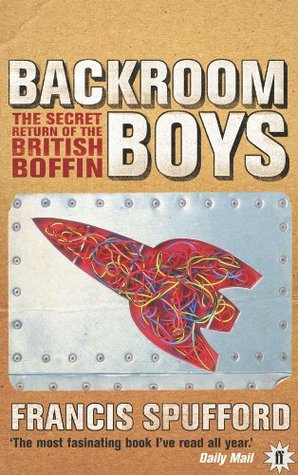
Backroom Boys: the secret return of the British Boffin by Francis Spufford

So I had a minor hissy fit of nerd-rage last week just after starting to read Backroom Boys. I may or may not have been every so slightly over-the-top in my reaction to one particular sentence, but I unabashedly stand by my point that the sentence that offended my inner nerd should not have been in the book.

Once I got past that sentence (and the frequently poor punctuation of the Kindle edition), Backroom Boys is actually a cheerful read. Looking at British engineering through a series of case studies makes for a surprisingly entertaining journey. The book achieves this by leaving out the vast majority of the science and focusing on the anecdotes and tall tales of each project. It turns scientists and engineers into characters. Not just any kind of character - all the Brits are quirky eccentric underdogs.

Underdogs need to be pitched against something, of course. The Boffins tend to struggle with short-sighted politicians who chronically underfund them, and in one episode, with an American cut-throat competitor whose plans would slow progress by decades if he were allowed to succeed.

The book illuminates one of the fatal flaws of British policy makers: in the post-war period, they have been crippled by indecision. Unwilling to commit fully to any particular direction, they have spread their energies thin - and this thin spread has kept entire technological sectors on timid life support, but without the ability to succeed or flourish. Then, under Thatcher, the leftover survivors were largely culled.

(The one shining success - Vodafone - turns out to come from Thatcher's policies, but a keen-eyed reader might spot that it's a corrupt and toxic victory: when the government decided to set up two competing mobile phone networks, one was predestined to be cellnet / BT, and the other was given to a small company from the military sector. That company would not even have bid for the contract if Thatcher's government hadn't nudged the owner and tipped him off that his outfit would get the contract if they put in a bid. So, helped by a dollop of nepotism and plenty of wink-wink, nudge-nudge, a military radio maker got a shot at becoming a global mobile network giant and launched Vodafone...)

This book won't teach you anything about science, and it won't change your view of the world or teach you something useful you didn't already know. But if you like a few anecdotes and tales about underdog engineers struggling to shine despite the adversity of the powers that be, then Backroom Boys is the cheerful romp you should read.

Rating: 4/5

Monday, 16 February 2015

Backroom Boys - a pre-review of RAGE, a handful of pages into the book

Today, my beloved Kindle found itself dangerously close to being hurled at a wall in anger. I guess this is one of the few things where having a paper book is superior to e-readers...

The cause for said near-miss was a minor burst of rage, and that rage, in turn, was triggered by the book Backroom Boys - one of the books I bought because Jo Walton recommended it in "What Makes This Book So Great". I fear on this occasion she may have led me (and other readers) up the garden path...

I'd only just started reading Backroom Boys. It seemed cheerful enough, although the significant number of missing apostrophes was already grating my patience into thin slivers. I figured this was probably an issue caused by the transfer to Kindle (when publishers use OCR to generate manuscripts for Kindle, things don't always work very well). But then came this whopper:
You have to pause for a moment there, as the rocket's vertical movement paused, with the forces of lift and gravity briefly equalised, and contemplate the strangeness of the place it was in, (...)
Oh wow. That fizzing and bubbling you hear? It's the sound of my blood boiling. This is the sort of throwaway remark that might be only mildly annoying in a second-rate scifi novel. It would be quite annoying in a good science fiction novel. But this is a supposed work of non-fiction, dedicated to celebrating engineers and ingenuity! How dare they!!!

Now, I hope it is very obvious to everyone what is wrong with that sentence, but just in case it's not, let's list all the problems:

1) Gravity is not a force. Gravity is a force field - the force it induces in a body, depending on its mass, is weight.

2) The author does not understand what lift is. Lift tends to be defined as the aerodynamic force perpendicular to the air flow that a body generates. (Sometimes, it can be defined as total upwards force, but that is a bit rarer). On rockets, the things that generate lift are the little steering fins (or any wings that may be attached to the rocket). The main force that pushes rockets upwards is thrust.

3) Let's for the moment assume the author defines "lift" as the total upward force and "gravity" (oh, how I cringe) as the total downward force. Then, guess what: in the moment when the rocket's vertical movement is paused, the two forces are not equal(ised)! In fact, at that precise moment, there is no "lift" at all (regardless of which definition you use: at that point, the rocket is outside the atmosphere / in space, so there is no aerodynamic lift, no thrust, no upward force). There is only the rocket's weight. The only force working on it is the downward force. The reason the vertical movement pauses (for an infinitesemal moment) is that its upward movement is being continually counteracted by the downward force (the weight) - force is mass times acceleration, and the rocket has been accelerating downwards ever since its "lift" (i.e. upward force / combination of thrust and aerodynamic lift) has stopped. If the two forces were equal, then the rocket would fly in a straight line (that's how planes work): it would not fly a parabolic arc.

So, about 1% into the book, the author gets the most fundamental Newtonian physics and the most fundamental language of engineering fatally, embarrassingly, shockingly wrong. I would expect anyone who finished secondary education to know these things, so of course it is disappointing in any book written by an adult. But this isn't just any book - it's a book meant to celebrate engineers and ingenuity. How can it celebrate them if it does not respect their work enough to get even the most basic fundamentals right?

And, more importantly, how am I supposed to trust later chapters, which presumably touch on sciences I know much less about, if I can see that the author didn't have the slightest clue about the topics that I do understand?

I may continue reading, but for now, I seethe...

UPDATE: I have finished reading the book. It was better than that sentence. Click for the review.

Saturday, 14 February 2015

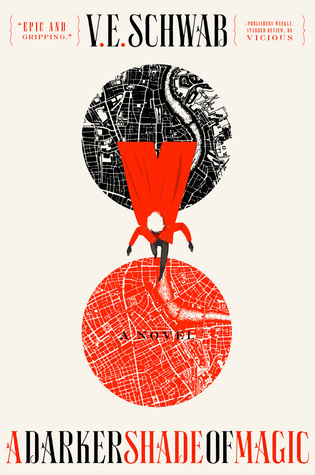
A Darker Shade of Magic by Victoria Schwab

A Darker Shade of Magic is a book that knows what it wants to achieve: swashbuckling adventure, likably spunky but tough heroes, plenty of energy and fun. With magic. It doesn't do too badly.

There are four parallel Earths in this book, each just a quick dimension apart. Each has a city called London in the same place on the Thames, but they have different languages, different countries, different histories. The biggest difference, however, is the level and role of magic in each city.

  • Grey London has almost no magic - and matches our London under Mad King George.
  • Red London is rich in magic, and people live in harmony with the magic.
  • White London is poor in magic, and people strive to steal, control, and dominate the magic as much as they can.
  • Black London is dead: here, people had let themselves be controlled by their magic, and the world had experienced a mysterious apocalypse as a result.

There are only two magicians left who can travel between worlds: Kell, from Red London, and Holland, from White London. They act as messengers between the royal families of the three Londons that are still accessible. Black London has been sealed off to prevent its apocalypse from spreading into the other dimensions.

Kell is our hero, and the story really kicks off when he smuggles an artefact (which is treason) that turns out to be a relic from Black London (which makes it powerful and dangerous). Suddenly, all kinds of nefarious characters and thugs are after Kell. To make things worse, he gets entangled with Lila, a tough teenaged orphan girl from Grey London who wants nothing more than to be a pirate captain and see the world...

A Darker Shade of Magic has all the right ingredients: a good pace, repartee between the good guys, sinister and creepy baddies, adventure and magic... it's great fun to read.

It's not flawless: there are some holes in the plot, and while it is nominally set in (four) London(s), Grey London doesn't quite feel like UK London to me. In terms of plotholes, it's never quite clear what the royal families in the different Londons have to say to each other / why any connection continues to exist, and what magic can and can't do is quite nebulous. It feels a little as if the author hasn't quite worked out the workings of magic in her worlds. Still, these are flaws only some (overly pernickety) readers will mind: I think most readers who like to read the occasional fantasy novel will thoroughly enjoy A Darker Shade of Magic. I certainly did.

Rating: 4/5

Friday, 13 February 2015

The Bear by Claire Cameron

I got about 19% through before giving up.

The Bear is told through the narrative voice of a five-year-old girl. It's a very stream-of-consciousness, go-off-on-a-tangent sort of voice, which may or may not be a convincing literary device in a novel told through the eyes of a child. However, this is a novel told through the eyes of a child whose parents are being attacked and eaten by a bear. (And later, presumably, a child fleeing through the woods with her toddler brother: by the time I gave up, one parent had been partially eaten and dismembered; the other was merely paralysed through a broken neck and gravely injured / not quite eaten yet). In that context, the writing voice simply does not fit, or convince.

At one point, the children are inside an empty cooler box, which is semi-locked (a rock features in some way to keep the door slightly ajar, while it is locked enough to prevent access). The bear gets interested. It tries to open the door with its teeth, with its nose and teeth protruding inside. Scared of the "big dog" and its long, long teeth, the girl nevertheless compares the shine of the black nose to the leather on her grandpa's sofa. If it was a throwaway remark / description, that might still just about work, but then we get a page-long memory of her grandfather and his TV/sofa habits, WHILE A HUNGRY BEAR WITH BLOODY SNOUT IS GNAWING AT THE DOOR to the cooler she is in. Even the most scatterbrained, short-attention-spanned child would not, in my opinion, get distracted from a hungry mouth full of scary teeth trying to get at her. 

As far as I read, the book relies heavily on the sheer drawn out horror of events - and the fact that the children are unaware of what is really going on, but have a sense that something is very wrong. The horror is visceral, complete with extensive feeding noises, dismemberment, screams, etc. - imagining a toddler and a five-year-old in that context is brutal. However, the narrative voice ruins it by being ridiculous and unconvincing. Not that it would be a joyful reading experience if it were more authentic: some horrors are too gruesome to make enjoyable entertainment, especially as the foreword points out that the details of the bear attack are an account of a real incident. Basically, much of this book is not just torture-porn, but snuff literature. It's hard to see it as being anything but a badly written book, in very poor taste. 

Really not recommended at all.