Friday, 24 February 2012

The Man Who Rained by Ali Shaw

Ali Shaw's first novel, The Girl with Glass Feet, mixed magical, fairy-tale-esque materials with a surreal island and a story about melancholy, obsession, love, emotionally stunted men...

All in all, I enjoyed it, but started noticing that it was a very, very emo read.

The Man Who Rained amps up the emo sensibilities to eleven, squeezes in even more magic, moping, wallowing and melancholy, and, somehow, falls completely flat (for me). In fact, it was so disappointing, I started to wonder whether I might have been completely misguided about liking the Girl with Glass Feet.

The rest of the review covers about a third of the plot, so if that is too much, then consider this a SPOILER WARNING.

The premise: young woman, after the death of her father, dumps her boyfriend, decides to start a new life in Thunderstown (a remote place she has only ever happened to see from a plane, and where all the streets are in a spirally layout making it look like a weather system / vortex from above). Her father was "weather powered" - a man who only ever felt alive when watching weather, and whose time in prison crushed the life force and sanity out of him.

In Thunderstown, there are weird things going on: stray dogs are meek creatures, executed by the culler by means of breaking their necks in a hug. And there are strange charms dangling everywhere. People are a bit sinister, or gentle old souls, but rarely in between. She walks up one of the four mountains around the town, and a young, grey, hairless man strolls into view just as she's hidden away in a ruin, gets naked, and turns into a cloud. She's naturally fascinated by this cold, clammy, grey skinned person. The rest of the story is all about how weather materialises as living things around town, and how townspeople are scared of weather, trying to control it by having it killed...

Far-fetched doesn't come close. But I can live with far-fetched. It's inconsistencies in internal logic that I find difficult (this book has a few), and, ultimately, the fact that hard as it might try, the magic spark just wasn't there. I never felt very involved or engrossed, and all the wallowing and moping ended up being quite annoying. Some of the final plot twists made no sense at all, while other plot developments were so obvious in advance that I wanted to slap the characters for not seeing them coming...

Perhaps one needs to be in a certain mood or mindset to enjoy Ali Shaw novels. Or perhaps the first novel is simply miles better than the second. I don't know.

Rating: 2/5

Wednesday, 11 January 2012

The Cardturner by Louis Sachar

A rich, mysterious, cantankerous uncle. A hint about cards. Was I the only reader who, forgetting the blurb on Amazon, briefly thought I was about to read a book about a magician (stage or otherwise)?

But nope, The Cardturner is a book about the card game Bridge. It also has a story - a very neat and nice story about a teenager and the uncle he is meant to endear himself to for the inheritance. But primarily, this is a book trying to get young people interested in playing Bridge.

Well, I thought a lot of the Bridge stuff went way above my head. It's a bit like the latter chapters of Cory Doctorow's Little Brother in that regard: you sort of feel you've been learning and understanding a lot, some of it quite complicated to envision in your head, and then it just breaks through the threshold of "I can follow this" and into the territory of "I'm a bit lost, but carried along by the story".

There are various questions that formed in my mind (how much dialogue can there really be, in the bidding process - it only goes through two or three iterations in all the examples in this novel, so hardly enough to make meaningful communication possible! And how can it be rewarding to play a turn based strategic battle game that can only last through 13 turns? Etc.) - but there is enough excitement in the story, and a sense of the panache involved in some of the Bridge manoeuvres, that I really enjoyed the novel.

OK, so like Holes (the other Louis Sachar novel I've read), there seems to be a bit too much affection for neatness. Holes had various back stories that all tidy up nicely in a way that makes the novel feel like destiny. The Cardturner allows itself a rather large dollop of creative freedom in its interpretation of schizophrenia / ghosts...

But it's a beautiful novel, nonetheless. It's for young people, but I loved reading it, even if I felt that the story was a little too neat and cute for its own good. (That said, there were some jolts that I felt quite acutely as a reader, moments when the story had big impact in not entirely the expected way).

One flaw were the asides to the reader - each time the author writes something like "if I were a better writer, I'd have..." or otherwise acknowledges the writer / reader interface, I feel a little annoyed.

Still, I'd recommend this book. It's a cracking read.

Rating: 4/5

Thursday, 20 October 2011

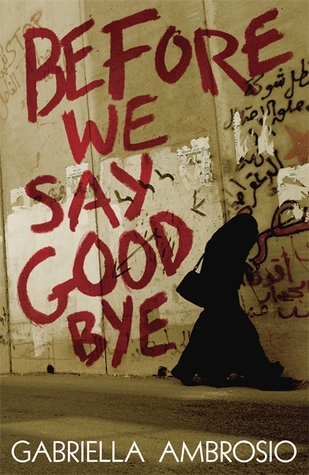
Before We Say Goodbye by Gabriella Ambrosio

Before We Say Goodbye is a beautifully written, very short novel / novella. (I think it takes about 2 hours to read it all). I read this in bursts - nearly half of it in one go while waiting at an airport, then, months later, another chunk.

Why the months of reading other things? Because, as beautifully written and effective as this novel is, it is not an easy read. The book has a dreamy atmosphere - even though it is extremely well grounded, too. A strange thing to say: a book that feels like a (bad) dream, and almost like journalism, all at the same time.

Initially, I struggled a bit (one character's internal process is a bit surreal, and I can sometimes find the surreal a struggle to read). But once I got past the discombobulation that the sheer number of characters (and different names, all of which sound equally alien to my ears) and the occasional episodes of a near-feverish imagination engender, it is a very rewarding book.

On some levels, I want to set aside a few hours and read it again, all in one go, to appreciate the craftsmanship of the writing, the detail, and the emotional depth. On another level, I may never read it again at all. The dreaminess is not just pretty, it is sinister, too, and there is that feeling of inevitability that sometimes haunts a dream.

If you watched Paradise Now, or if you read Joe Sacco's Palestine, and were able to appreciate (though not, perhaps, enjoy) these, then Before We Say Goodbye is likely to be well up your street. It is so beautifully crafted, there is almost joy in reading it - though it is filled with sadness and despair...

Rating: 5/5

Monday, 29 August 2011

The Dervish House by Ian McDonald

The Dervish House starts with a bang: a suicide bomber blows up her own head on a tram in Istanbul. The rest of the novel tells the stories of a wide variety of characters who either live or work in the Dervish House. One of the characters was a witness to the bombing, but the others are simply people who share a common geography.

It is a novel about many things: science fiction (nanotechnology is a big part of this novel, as are designer drugs), interconnectivity, myths, stories, history, Istanbul - above all, Istanbul. There is fascination in this novel - fascination with a city that squats right across a natural funnel for trade and ideas and peoples, that has a rich history and atmosphere unlike any other. The novel is deeply atmospheric, beautifully written, and captures Istanbul very well.

The characters, meanwhile, have different plots and stories. There's the little boy with a heart condition who explores the world through his robots and dreams of having big adventures - and who starts investigating the bombing and its aftermath. There's the old Greek professor of economics, a friend to the boy and a forgotten, sidelined academic, who tries to see the bigger picture, and who is asked to help out with a security think tank. There's the woman owning a gallery and antique shop who is asked to source a legendary relic for a million Euros - a relic that may just be a myth. There's her husband, a cocky trader on the stock market, dealing in options and doing exactly the sort of business deals that are currently on the brink of bringing capitalism to its knees. He's planning a major deal to smuggle (illegal) gas into Europe. Finally, there's the witness to the bombing, a man with a gruesome history, who starts seeing supernatural beings...

There are lots of other characters, drawn in vivid colours and compelling detail, in the story only for moments and gone again, or recurring. Ultimately, the plot lines do interweave and pull together in an exciting finale. Regarding the plotlines - they are thrilling and exciting, by and large, though some can be quite slow to build up momentum. The quest for the Mellified Man has something grandiose about it, and it powers the interest for much of the early parts of the novel, while other plotlines are slower to build up to their grand adventures. Some of the characters are less than likeable - but it is clear that the author admires them a lot. I found the cocky trader immensely annoying: a sleazy, slick bag of slime, and yet the writer seems to be rather sympathetic to him. The tomato girl / marketeer is, like the trader, a shallow, slick person, and similarly difficult to like. There is a pattern here. The child dreams of adventure, the adults in their youth dream of money and power, the old dream of the lives they did not lead... in flashbacks, we see the older people in their youth, and they dreamt of revolution, making them eminently more likeable even in their foolish years than those who just dream of money and status. There is grand adventure in the novel, and melancholy, and sadness, and joy, and a lot of capitalist greed and confident swaggering. There are ideas about technology and the future. There is religious fervour, too, in some sub plots...

It is a very good novel, a novel rich in ideas and emotions and atmosphere. I found it a very rewarding read and I would heartily recommend it to anyone.

Rating: 5/5

Monday, 15 August 2011

City of Veils by Zoë Ferraris

City of Veils, the sequel to The Night of the Mi'raj / Finding Nouf is another crime novel set in and around Jedda in Saudi Arabia. It could probably stand on its own without the first novel - but it does continue some of the character relationships that were slowly established previously (after a gap of 8 months or so).

The two heroes from the first novel are once again central to the plot: Nayir, a desert guide and very devout Muslim, and Katya, a woman working in the Forensics department of the Saudi police force. Two other big new characters are now part of the plot: Osama, a police officer who is more confident and less spiteful around women than many other men, and Miriam, an American woman who lives in Jedda.

The story starts when a female body is found on the beach: badly burned, stabbed, beaten and decaying. Meanwhile, Miriam returns from a month-long holiday in America to be reunited with her husband, who promptly forgets to pick her up at the airport, and then, barely having brought her home, disappears.

This is the tale of an investigation into the murder - and also the tale of an American woman suddenly isolated and alone in one of the scariest places on Earth to be a woman in. The premise is interesting, to say the least.

The novel is a smooth read. This time, there is more tension worked into the plot. We're still not in serial-killer-territory, but there is a sense of peril around Miriam. The murder, this time around, is very obviously a violent murder rather than a possible murder. (In the first novel, it is an unexplained death for the longest time, and there is not much of a sense that more violence might occur). More tension in this book means a brisker pace - but there are also more characters, and this imbalances the novel a little. Not every plotline is as tense as every other plotline, so it can sometimes feel like one chapter is hitting the accelerator, while another is shifting down a gear and meandering a little.

By far the most awkward angle of the novel is when it strays dangerously close into The Da Vinci Code territory. Its heart is never in it, and this is not a novel about religious conspiracies - yet there is a sprinkling of this in the plot, and as reader, I felt myself cringing and hoping that it would not develop into a Dan Brown clone. It never does - but it dabbles with the idea.

Much of the attraction of Night of the Mi'raj was that it introduces an alien land that not many people experience. City of Veils feels even more immersive in Saudi Arabian culture - sometimes intentionally straying to the sort of scene a Western reader might have expected, but found missing in the first novel. Does it always convince? I'm not sure - the police is written about in a respectful and competent manner, and in many ways, these could be investigators in any country. Yes, there are cultural differences, but there are no fundamental differences in the characters of the people. Are people really more or less the same, all around the world, just adapting their lives into different behavioural patterns, but without deep-rooted differences? I don't know - this book makes it feel that way. It does not help that it's all written in English, so characters use swearwords like "f***" when things go wrong. Basically, everyone's speech patterns are American (with a few common Arabic words thrown in), while their behaviour patterns are Saudi.

I enjoyed this book a lot. I enjoyed it more than the first novel - it has more tension and peril in it. I also think it would probably make a fantastic movie. But it is somehow not quite perfect: characters are a bit too self-analytical, a bit too explanatory, the narrative tone a bit too removed to be fully immersed. It's a novel that comes within grasping distance of genre-defining greatness, but can't quite capitalise on its great ideas and concept to their fullest potential. Well worth a read, definitely, but probably not a second, third or fourth read.

Rating: 4/5

Wednesday, 27 July 2011

The Night of the Mi'raj by Zoë Ferraris

In the Saudi Arabian desert, a body of a young girl is found, after a search of nearly two weeks. The rich and influential family have some words with the authorities, and the death is quickly declared an accident.

But of course, that is not the whole story in Night of the Mi'raj (later retitled 'Finding Nouf'). The tracker they've asked to help them find the girl is now secretly tasked with finding out what happened. He's a Palestinian, devout, a single man, and conservative / obsessed with modesty. Now he's looking into the circumstances around the tragic, possibly violent death of a teenage girl...

It's a compelling backdrop to a crime drama. Inspired by inspector Columbo (our hero, too, soon finds himself wearing a trenchcoat and questioning people who have things to hide), and working together with a woman working in a forensics laboratory, he slowly reveals layer upon layer of mystery.

This is not a thriller: there is not much of a sense of threat around the story developments. Instead, it is a murder mystery in the most classical sense. It took me a while to adjust to this - perhaps I am too used to cliffhangers at the end of each chapter, and heroes being chased, conspiracies, dark shadows around every corner. Once I adjusted to the more sedate pace, this was a compelling read. I'd bought it because I wanted to get a sense of Saudi Arabia, and I feel that I did get a glimpse - told in functional, but undecorated prose. It was not quite as atmospheric as I had hoped.

So, if you like TV murder mysteries like "Murder she wrote" or "Diagnosis: Murder", or Agatha Christie novels, and you want to combine that sort of plot with a bit of cultural sightseeing into countries you might never visit, and attitudes that you might find quite alien, then this is an excellent book for you. Personally, I would have preferred a bit more tension, a bit more of a sense of urgency, and perhaps more of a presence for the religious police, but I found the book pretty good.

Rating: 4/5

(Addendum: this book turned out to be the start of a series which improved massively with each subsequent book: the second one is very good, the third is superb.)

Sunday, 24 July 2011

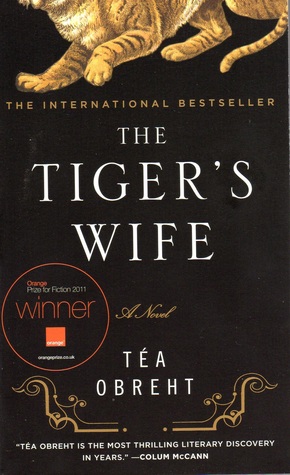
The Tiger's Wife by Téa Obreht

Our narrator's grandfather is dead. She's en route to an orphanage, about to vaccinate the children, when she finds out. It's an orphanage across the border, in the Other Country - the one that Her Country has fought a war with. And she continues her journey, reminiscing about her grandfather, and stories, family stories, local myths...

The Tiger's Wife moves from one story to another - one moment, we're reading about her grandfather's encounter with the deathless man, the next it's the story of the zoo during The War, or the tiger (there are several tigers in the novel), or the bearhunter...

We're never quite sure which former Yugoslavian country we're in, but it does not seem to matter much. Stories are stories.

There are many things to like - and perhaps even love - about this book. It has a talent for including fairy-tale-like stories in a normal narrative. Many of the characters get a tale that sounds a bit like a fairy tale. Compared to movies, this is probably closest to Amelie, or Life Is Beautiful, or A Very Long Engagement in tone. (In book terms, I suspect Salman Rushdie is the closest writer I have read).

Some of the above are movies and stories I love, and yet, I did not feel the same way about this book. Don't get me wrong: I really enjoyed many parts. If any of the characters had said "Life is like a box of chocolates", I would have nodded, and thought, yes, in this book, it is. But that's also what is wrong with the story, for me. This is a book about a war-ravaged region, about great tragedies, angry mobs, violence, and some truly horrific events. And yet, it is coated in an aesthetic that is a bit romantic, nostalgic and bittersweet. I find bittersweet a difficult flavour to enjoy, especially when it comes to the great disasters and human capacity to bring about tragedy. This book makes war look cute, not gritty. It gives forced marriages and wife beating a kind of golden, nostalgic glow...

Basically, it feels like violence and war, the HDR photograph, scored by Yann Tiersen.

I don't quite feel this is appropriate.

Some people will argue that being able to laugh and poke fun at something is a part of growing pains, of gaining distance and perspective on it. I can't argue with that. Sometimes, it works (Tales From The Golden Age is a Romanian movie that does more or less that to Ceaucescu's reign). In this particular case, it did not work for me.

Some notes about reading this book: I read it whenever I had time, for whatever amount of time I had. Which means I did not read it chapter by chapter. This was a mistake. The story moves from character to character, never sticking with a narrative for very long, and is only held together by fairly thin framing. Often I would find myself trying to remember who I was reading about, and why, and what their role was. It can be quite a bewildering reading experience.

Another thing that I found a bit awkward is that I kept waiting for a resolution, some answers... well, this was not forthcoming. Or maybe I just did not find the resolution fitting for the story.

All in all, it is a book with some lovely stories, some lovely moments, a lot of sweetener applied to some horrible stories and bitter moments. Well written (albeit without ever justifying its sometimes omniscient narrative voice, which also jumps from one first person narrator to another), but not altogether a great book. Too sweet for its subject matter for me, and a bit too helter skelter.

Rating: 3/5