Saturday, 28 July 2012

Cwmardy by Lewis Jones

So, a communist activist, miner, public speaker and thinker in the 1930s is encouraged by friends to write a working men's story of the Welsh valleys, to give the world a glimpse at what it is like to live there and then, for regular people. The result is Cwmardy. (I have not read its sequel, 'We Live', included in this double bill)

The book has a lot going for it. Or rather, it should have a lot going for it. The story is told in easily accessible language; it features sex, violence, war, intrigue, conspiracies, high drama... purely in terms of "stuff happening", the novel is not that far off a thriller.

Then why is it so boring?

The answer is simple. Unfortunately, this novel is basically a soap opera set in the Welsh valleys. Stuff happens, but it's the story of (fictional) people's entire lives - not the story of a single, thrilling part of their lives. The book simply does not have the structure of a story, but is instead a neverending, eye-on-the-wall list of events.

A thriller thrills by giving us cliffhangers (usually at the end of chapters) and plot twists, revealed with impact and panache. The author of Cwmardy does not do either of those things - in fact, each chapter title gives away what the chapter is about. Chapter titles herald the plot twists, rather than setting up any kind of tense anticipation.

Meanwhile, our characters basically just want to get on with their lives. They don't seem to have big dreams and ambitions. Their struggles are, for the most part, everyday ones rather than anything exceptional enough to make a novel exciting. Even when they experience dramatic events, these are somehow narrated in such a matter-of-fact way that they aren't brought to life. They're also fairly flat characters.

Big Jim is a friendly, strong oaf, always ready to be a bit rough. Len is a more physically fragile, political young man. His mother is a mother hen, pecking at Len and Jim but ultimately always there for them. Ezra is a leader figure with doubts. Mary is intelligent. Jane likes boys. The characters all have their functions, but rarely have moments when they come across as fully human. For me, the one outstanding moment of humanity was when Len had to deliver the news of a death to the wife of the dead miner: standing at the door, he chokes up at her expression of horror as she guesses a tragedy has occurred, and tells her that her husband had a "little tap" but would be alright soon enough (even though the miners carrying the body can't be far behind). It is a rare moment that seems complex and human and unpredictable. The rest of the novel is only rarely unpredictable.

It's a book that sets out to tell what life is like for Welsh miners in the early 1900s. It does not set out to entertain. It wants to make points, and as such, it is functional, matter-of-fact, sometimes preachy, full of characters that are walking illustrations of arguments rather than people in their own right. The end result is a boring narrative that is often predictable and never entertaining... basically, it's about as rewarding an experience as walking into a small local town museum, with its faded black and white photographs and a few pickaxes in glass cabinets. If you feel excited about Welsh mining heritage, this book is for you. Perhaps even if you like endless soap operas. I don't have any fondness of either, so it really wasn't a book I'd recommend.

(To its credit, the book has some quite harrowing / affecting passages, and, especially early on, quite a few uncomfortable scenes of brother-sister intimacy - but once Len starts working in the mine, the novel is just a lengthy slog with axes to grind and points to make. Even the worst possible workplace harrassment / bullying for people to join a Union is glorified as harmless prank / a justified way to teach a lesson.)

Rating: 2/5

Wednesday, 18 July 2012

Sixty-One Nails by Mike Shevdon

One morning, on the way to work, the London Underground proves to take Niall Peterson to his limits - a suicide next to him, closures, disruptions, stressful phone calls to his ex-wife... no wonder he has a heart attack.

No wonder he dies.

Then he wakes up again, revived by a grey-haired elderly lady, and nothing will ever be the same again, for now he is one of the Fey, the Fair Folk, the Others, the mythical, magical races from stories.

Sixty-One Nails is a novel of urban fantasy set in London. Few cities inspire as much urban fantasy as the big smog, and Sixty-One Nails is one of the better novels set here. The atmosphere is often rich and engrossing - if Hellboy 2: The Golden Army was to your liking, or perhaps Rivers of London by Ben Aaronovich, then chances are, Sixty-One Nails will be a pleasant experience, too.

Being the first novel in a series, we basically spend most of it learning the rules, receiving exposition, and following Niall as he stumbles from one enigmatic, secretive mentor figure to the next. A lot of thought clearly has gone into the meshing of myths and urban world, and it is well executed.

However, the novel disappoints a little on the editing. A lot of the dialogue is a bit clunky - treading the same ground several times over in quick succession, with repetition, questions being asked and answered the same way several times in the same scene. The amount of repetition is quite grating - it's as if the author needed to get some exposition delivered, had a go at it, wasn't quite happy, had another go, was happier, then decided to reinforce the point by having yet another go, and then, after delivering the same tidbit of explanation/exposition three times over in a single scene, decided to keep them all in the draft. I would have expected an editor to rein in this nonsense a bit. The dialogue also tends to meander a little, sometimes modern, sometimes in noble fair folk speech pattern, sometimes in enigmatic mode... the characters do not feel like they are quite settled, yet. As well done as the story is, the repetitive streak, occasional stylistic inconsistencies, and sometimes clunky descriptions let the book down - all things that a good editor should have polished away before sending the book to the printers.

As it is, this is an enjoyable read, and one I would recommend to people who like urban fantasy novels, London, or novels about the Fair Folk, but it falls a bit short of the highest standards / benchmarks. I wouldn't really recommend it to people who are not already fans of (urban) fantasy - it could have been on a par with the best, but as it is, it's just a bit too rough and unpolished.

Rating: 3.5/5

(I have since read the two next novels in the series, and to my disappointment, the lack of editorial intervention continues throughout the series. I gave up after that, as the frustrations built up)

Wednesday, 27 June 2012

Whispers Under Ground by Ben Aaronovitch

Whispers Under Ground is the third book in a series. I'd definitely recommend starting at the beginning for anyone interested in this series - the book largely assumes that the reader is familiar with the characters and at least some of the previous events. There isn't a huge amount of direct plot continuity, but without reading Rivers of London and Moon Over Soho first, you'll probably find this book quite bewildering.

So, Peter Grant, the Constable working on uncanny / weird / magical stuff for the Metropolitan Police, is back in action, investigating ghosts, goblins and things that go bump in the night. If this sounds like a children's series, then don't be deceived: it's a series of "urban fantasy" for adults.

This is by no means the only urban fantasy novel - this is a lively sub genre. London, in particular, is the hero of many urban fantasy tales (Neverwhere, Un Lun Dun, Kraken and many more).

However, most of the urban fantasy novels I've read so far struggled to get the balance right. More often than not, the fantasy element and the urban setting start out aligned, but slowly become separate during the course of a novel.

The Peter Grant series is the one outstanding exception: here, fantasy and urban setting stay well and truly on the same page. Mixing irreverent, funny police comedy narrative with hocus pocus and a deep-rooted, affectionate knowledge of London, the book oozes all the right things: convincing London atmosphere, fascination with urban mythology, and a world of supernatural goings-on that feels just about credible. Whispers Underground tackles the iconic tube (and sewer) systems of London - and anyone who has ever lived in London will know that there are many myths and legends about these. Londoners love knowing that there are long-abandoned stations and branch lines, WW2 shelters, and other relics of the city's organic evolution, hidden away from sight but alluringly glimpsed from passing trains if you know when to press your face against the tube window... In short, the Underground is a setting with huge potential - and Whispers Underground lives up to that potential.

Whether we're in disused tube tunnels or sewers: the darkness, smells and convincingly authentic myths we encounter with our hero, Peter Grant, are richly atmospheric and beautifully brought to life. The first person narration, meanwhile, is quirky and amusing. I laughed out loud quite a few times - I get the sense this book contained a lot more gags / humorous dialogue than the two predecessors. (The only flaw: some of the dialogue sees ALL the characters wise cracking, a bit like the cast of the movie Lake Placid, so they don't feel entirely individual when they speak). But the thing that really, really lifts the Peter Grant series above most urban fantasy is that our hero once wanted to be an architect, and has a fantastically vibrant way of telling the reader about history and describing buildings, whether ugly concrete blocks or Victorian town houses. Reading the book is almost like a tour of the city - but a tour led by a wizard policeman. What could possibly be better than that?

Unlike the first two novels, the main plotline in this one is a little more reserved. There is less scenery-churning, super-powered villainy, less operatic evil, and less of a feeling of supercharged threat. However, this only seems to make the book better. It might not build up tension in quite the same way, but it feels more grounded and authentic and pleasant than the first two novels. The series has settled into a certain rhythm and is now flowing along with joy and happiness rather than feeling the need to amp up the shock factor.

In short, it's the best book of the series so far - and a huge delight to read.

(If, that is, you like funny, fantastic, London-based supernatural magic police popcorn literature. Which I do.)

Rating: 5/5

Tuesday, 12 June 2012

Nights at the Circus by Angela Carter

Angela Carter is one of those writers who have been on the periphery of my personal reading radar for a while. Feminist friends revere her work. She's one of the big literary names who deal in fairy tales. And she's been massively influential.

Nights at the Circus is a novel about Fevvers - a cockney pronunciation of Feathers. She's a miraculous woman who has wings and can fly, and she's found a career as an acrobat. The book is divided into three parts. In part one, she tells her story to an American journalist, backstage in a London theatre, over the course of a night. The journalist wants nothing more than to prove her fake and burst the bubble of her fame. In part two, she starts on a world tour with a circus, and the journalist, seduced by the mystical attraction of circus life, follows along, signing up as clown and living incognito in the circus. Part three, ... well, I'm not going to spoil the story.

The novel is written in quite dense prose. It is not a quick read, and requires some concentration. The story moves in unexpected ways, and every aspect of the novel becomes more and more surreal and dream-like as it progresses. Starting with a relatively straightforward biographical narrative, the growing sense of unease is infused into the story gently: something odd is happening with the passage of time. There are unspoken things, sudden changes in the flow of conversation, meaningful glances get exchanged.

In part two, the surreal / fantastical elements become more prevalent. Animals are different. Clowns have their own mythos. Some magic appears to occur (beyond a winged, flying woman). And part three - well, all bets are off in part three, and we're deep into surreal, dream like, trance like crazy. Narrative voices change from first person to third person from one paragraph to the next (up to this point, all was in third person), among other twisted writing methods. Part three feels like a bit of an acid trip in the 1960s, in some ways. But the story still gets (largely) rounded off.

Underlying the novel are a rather large number of ideas, half-thoughts and notions about gender, women, men and feminism. Sometimes they are voiced by the author, in a carefully chosen phrase in descriptive text. At other times, characters openly discuss these themes (a particularly memorably dialogue is an argument about relationships where a maternal figure tries to convince Fevvers that falling in love might be more harmful to her self than prostitution would be). Sometimes, there are plot developments that are symbolic or metaphorical. Women, on the whole, fare best when they connect and interact with other women: even a whore house is utopian and idyllic, with no conflict between the whores, just as long as the men are not around. But as soon as men are involved, there is violence. Wife beaters, wife murderers, sinister religious oppressors, rapists... even our male protagonist at some point casually considers raping a vulnerable, almost unconscious woman who finds herself temporarily in his care, although it never goes beyond a hateful throwaway thought. Women without men (or children) flourish in this novel. Men (and children) bring suffering and complete loss of self.

No wonder Angela Carter's novels are dear to the heart of any English students tasked with writing essays about feminist literary theories.

Densely written and surreal, at times experimental - this novel is not my usual fare at all. It has some beautiful passages and chapters and ideas. Fevvers is a memorable character, cheerfully low brow, sweaty, smelly and untidy, described in vivid detail and imprinting herself in my memory.

Yet as a story, the novel is not entirely satisfying. There are long passages where I was bored as a reader. Some plot devices seem too strange to have meaning or reason. Some storylines remain unresolved. In short, by the time I finished reading, I felt only half satisfied with it.

Rating: 3/5

Friday, 8 June 2012

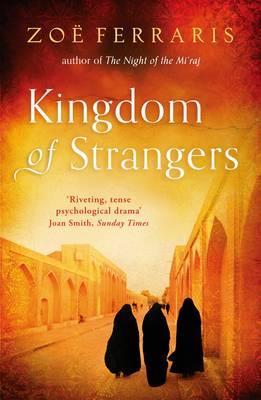
Kingdom of Strangers by Zoë Ferraris

Kingdom of Strangers is the third crime novel in a series set in Jedda, Saudi Arabia. It follows from The Night of the Mi'raj and City of Veils. Some of the characters from the first two novels make appearances, but the novel could probably be read on its own. (That said, the novel is much more enjoyable when you know the history)

By now it is clear who is the undisputed hero of this series: Katia, a female forensic scientist, working for the police, mostly stuck in a lab, but keen to have a more active role in the investigations. (The first novel centred more around Nayir, a Bedouin desert guide who got involved in a murder investigation and met Katia, but by now, Katia is the central pillar of the stories)

Kingdom of Strangers starts with the gruesome discovery of 19 dead bodies in the desert. A serial killer in Saudi Arabia - almost unheard of. And he's been busy, undiscovered, for ten years...

Meanwhile, the newly arrived inspector Ibrahim, tasked with leading the investigation, is having an affair outside marriage - and, when he turns up at his lover's flat, she is missing.

The novel is quick to set up its main plot strands, but chisels away at them at a pace that is steady, confident and not too rushed. It's not the sort of novel where each chapter ends on a cliffhanger, and each cliffhanger is more unbelievable than the last. Instead, the tension is amped up at a steady, confident pace, and the novel is engrossing all the way through. For a few chapters, I thought it might descend into stereotypes (serial killer toying with his pursuers, making it personal, etc.), but thankfully, the story stops feeling as if it were following a template soon enough.

One of the big attractions of this series has always been that it is set in Saudi Arabia - a country most of its readers might never set foot in (I doubt I ever will), and a country with a culture that is about as far away from Western philosophies as it is possible to get. The book treats its characters with a credible level of complexity, and the reader with a degree of respect. As Westerners, the readers would miss a lot of information if it was not spelled out, and so it is, but never in an obtrusive way. Exposition is handled masterfully. We are simply part to characters' thoughts and analyses - and those thoughts are often determined by the expectations of the society around them, and their own internal conflicts whenever they chafe against the limits (or when they transgress). There is an awful lot of chafing in this novel, but it seems quite credible that regular people in Saudi Arabia have to tightrope walk on a very thin line for much of their lives...

The book is not entirely without flaws. Coincidence, that cheat, does affect the plot, and one revelation is preceded by a cloaked premonition in a dream. Both are forgiveable - the novel would have worked just as well without the latter, and the coincidences are small in number, and occur early in the timeline of the novel.

Of the three Jedda murder novels written by Zoe Ferraris, this has become my favourite. I breezed through it in two days (which is fast, for me), and was completely hooked all the way through. Encountering an actual adulterous character - and his unique crises of conscience, challenges, and the threats hanging over his head - was an incredibly effective source of tension. It made the serial killer mystery pale by comparison, and turned this book into a real thriller.

I enjoyed the story so much, I would recommend the entire series to anyone. I would definitely recommend reading the first two books before tackling Kingdom of Strangers, just so this one can be appreciated fully. The preceding novels are both good books in their own right - but this one is absolutely brilliant.

Rating: 5/5

Tuesday, 5 June 2012

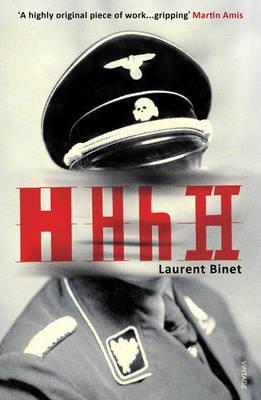
HHhH by Laurent Binet

HHhH. At first, I thought I was looking at cyrillic writing, or, perhaps, sanskrit. The same inscription, etched into the pages on the side of the book, adds to the mesmerising effect. A closer look, and I find myself realising that I am seeing Latin script after all - to be more precise, one letter, four times, in four fonts. I am intrigued enough to pick up the book, read the blurbs, read the back, and ultimately, intrigued enough to buy it...

The book, I am told, is a historical novel, about the (attempted) assassination of an important Nazi. It is an almost untold story of derring-do, resistance, and pluck. It is also a novel about the writer, trying to write his historical novel. In short, it is new, fresh, original, different.

Well, I am only partially deceived by this description. It is indeed a (presumably autobiographic) novel about a young Frenchman trying to write a historical novel about an assassination. Except, it is never a novel about the assassination - instead, it is also a novel about Reinhard Heydrich, the Blonde Beast, the Butcher of Prague, competent, cold and ruthless Nazi bureaucrat and leader.

Some assassins do appear - they are mentioned, in passing, in the first few pages, then forgotten until more than a third of the way through, then they disappear again until we are two thirds of the way through, and finally, about three quarters of the way into the novel, they make another appearance.

They are ghosts in this novel, barely there at all.

How come?

Well, this writer is obsessed and serious and wants to use only material that he has historic references for. No invention. No improvised line of dialogue. No description that is not taken from eye witnesses or photos or other historical record. No fiction in his history at all. (But even as principled as he is, he cannot keep this up, so he makes up some details, some conversations, here and there... and then, promptly, points them out in the next scene, points an accusatory finger at his own work and declares: this is where I lied, and thus, exonerates himself in his own eyes)

A lot is on the records about Heydrich. But his (wannabe) assassins - well, the Nazis took great care to eradicate anything and everyone to do with their deeds. Little survived. Barely enough for an interesting anecdote at a dinner party. Barely enough to fill a five thousand word novelette. Not even remotely enough for a novella, or a novel...

So the balance, in the historic bits, swings towards Heydrich. Brutal, calculating, almost idol-like Heydrich. Aside from his "Negroid" lips and his "hooked" nose and his "falsetto" voice, this imposing, tall, blonde, efficient bureaucrat is the ultimate Nazi, and our author cannot resist being ultimately "impressed" with Heydrich. Sure, he berates him physically (see the quotes above), spouts fury about his deeds, but, when all is said and done, we are left with the image of a fascinating, dominant man - perhaps the closest embodiment of the sort of Nazi that Christoph Waltz portrayed in Inglourious Basterds that exists in the historic record. Brutal and cruel, yes. Cold and ruthless, yes. Cultured, too: he plays the violin "better than Sherlock Holmes", we are told. And, in his own twisted way, principled: all the underlings he hires are chosen based genuinely on merit, rather than connections and belief in Nazism.


Perhaps to balance this growing sense of fascination with a dark lord, we are offered the odd vicious adjective or noun ("monster", "beast", "butcher", "perverted") and Heydrich's wife is described rather like a hysterical dominatrix. Other Nazis become animals (Hitler is a hamster, Göhring and Röhm are pigs). And no shortage of venom is poured over pacifists, appeasers and collaborators.

It is hardly intellectually challenging to read. Some sentences are so dripping with the author's judgement, they might just as easily have found themselves in the Daily Mail...

But even Heydrich is not allowed to be the dark (anti)hero of this novel. No, at its heart, this is a novel about writing novels. In a move that Charlie Kaufman might have been impressed by (see Adaptation), it is the author who really takes centre stage - him and his changing girlfriends, who meekly tolerate his historical obsessions and have little other than "passion" and a name each, but no real personalities or influence on his mind.

This author likes to quote other writers - up to seven lines from each, so he does not violate copyright and can claim "fair use" - and (largely) he likes to deride their methods, their clumsy prose, their expositionary dialogue. More rarely, he will offer praise (though usually a backhanded sort of praise). When not comparing his own approach to that of other, more established writers, we sometimes get a fiery rant, about writers or politicians or later, fame seeking murderers. And when not being ranted at, we get scenes bemoaning his challenge, and the importance of getting this right, to pay homage to those nearly forgotten heroes...

This writer is in love with himself and his own voice. But he does not have a high opinion of anyone else.

The book is fast, each chapter / scene merely a snippet, some no longer than three sentences. It is a book of polaroids - no, a book of tumblr entries, just a bit longer than Twictions, but not long enough to lose the reader's attention. Some scenes are entirely in one place and one time, others, barely half a page long, are transitions from present time to history or back again. This is not a novel in any traditional sense, after all. It is a collection of flash fiction. It just so happens that there is some interconnectivity between the pieces.

I did not dislike this book. I often enjoyed it, and breezed through it. But I did not feel as if I got what I had thought I'd bought. This was not a book about resistance and attempted assassination. It was not a novel. It was not historical fiction. Original, fresh, interesting: yes, but not wholesome - it does not make a whole.

In the end, the writer was too in love with himself, and not enough is known about the assassins and their lives and times to fill a novel without creative licence.

The book was not bad.

But neither was it great.

Rating: 3/5

Sunday, 11 March 2012

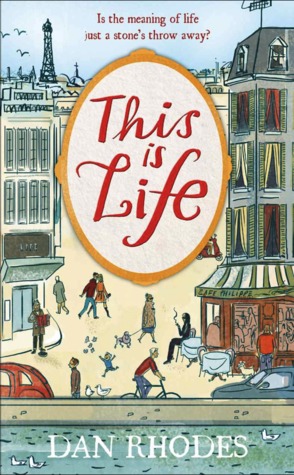
This is Life by Dan Rhodes

This is Life is a novel set in France. Correction, it is set in Paris. Correction, it is set in the cartoon version of Paris that movies like Hugo,The Extraordinary Adventures of Adele Blanc-Sec and Ratatouille are set in. (I know Amelie is missing on this list, but that's because Amelie has genuine magic, whereas the other movies just have the right sort of colours and tone, without feeling really magically French at heart.)

The book centres around Aurelie and various acquaintances and connections. Aurelie is an arts student, who, for her project, throws a pebble into a crowd find a subject she intends to draw pictures of for a week. The pebble hits a baby. After a brief telling-off, the mother of the baby hands it over and tells her to meet her again, exactly one week later, to return it, while she takes the week off.

Other stories are about an artist who is about to spend three months nude on stage, storing every bodily excretion in visible jars, and the story of Aurelie's friend Lilian who is so amazingly attractive that all men fall in love with her. Lilian breaks their hearts while searching for the one true love.

There is no shred of reality in this book: it's all sugarcoated and coloured with cartoonish glee. Which can work (and did, in Dan Rhodes' Little Hands Clapping), sometimes.

In This is Life, it does not work. There is a constant smirk on the narrative voice's face, a distant and slightly annoying tongue in cheek, lambasting artists, academics, arts students, the French, the French president, the Euro, women, the Japanese, romantically inclined men, ... basically, anyone and everyone in this book. More than once you will find yourself reading characters having conversations or thoughts that are basically an author, making a point / having a rant. The only character who is not annoying or being mocked is Herbert, the baby, and he has immaculate comic timing, blowing raspberries at just the right moment. (A strangely happy baby - he rarely seems to fuss and whinge and cry). In short, we are reading something that is written with a slightly superior tone throughout, and this grates.

It's all perfectly readable and not boring, but it lacks real joy. This is the sort of book that, were it a movie, would feature lots of music to induce the emotions it wants you to have, and a warm and cosy, but rich, colour palette, and somehow, in all the hubbub and cutesiness, some people may be convinced they are having a good time. And maybe, for other readers, it will work. For me, it did not. (Neither, I should say, did Hugo, the film. I get the strong sense that anyone who likes Hugo would also enjoy This is Life).

Rating: 3/5