Thursday, 12 February 2015

Cardiff Speculative Fiction Book Club: First Meeting Time & Place

It's time to fix the first meeting of the fledgling Cardiff Speculative Fiction Book Club, based on the results of the form.

  • The most popular meeting time is Tuesday 3rd March, 6pm.
  • The book for the first discussion will be Lock In by John Scalzi.

The easiest place to meet is probably the first floor of Wetherspoons Central Bar (the one sort of behind the KFC in Queen Street). It tends to be reasonably quiet there. After chatting about the book, we can then figure out where to meet for the second meeting (and what to read!)

I've created an event on Facebook: 


If you use FB, please do pop by, ask any questions, start conversations... or if you use Twitter, use a hashtag #cardiffsff to converse & make posts easy to find. Or use the comments on this blog.

Theoretically, there should be seven of us turning up on Tuesday 3rd March - that's a nice number if everyone turns up! (If you have filled in the web form and indicated that you can make it that day, please do get in touch if your plans have changed: it would be a bit awkward if there were 4 or 5 no-shows!!!)


Monday, 9 February 2015

The Galaxy Game by Karen Lord

The Galaxy Game is the sequel to The Best of All Possible Worlds. I suppose it could be read on its own, but many characters from the previous novel make appearances, and the book is so full of characters that already knowing some of them is a hugely useful crutch against the onslaught of names...

The novel has a prologue and epilogue set some years in the future (enough for our hero to be an elder, wiser man), while the bulk of the plot takes place when he's a teenager.

Rafi Delarua starts the novel in a school for gifted youngsters... no, not the X-Academy, sadly. He is suspected of having telepathic powers as his father has committed serious crimes using such powers. So the government has put him in a school that serves effectively as a quarantine institution. The school is there to find out what powers the kids have, and exploit / enhance / sequester them according to powers and character inclinations.

Rafi has been keeping himself in check: that is enough to make the school suspicious, and they decide to "cap" him - apply a hat which effectively reads his emotional state and broadcasts it to someone monitoring him, to see if he's really a psycho in disguise.

At the school, he has two friends: Serendipity and Ntenman. Serendipity is in love with Rafi. Ntenman is in love with her.

And from such a fairly simple start, things get side tracked, and side tracked, and side tracked again. This is not a story of youngsters in a school: quite soon, Rafi and Ntenman escape, visiting first Rafi's family and then escaping to a different planet. Serendipity is more or less forgotten about for about 3/4 of the book, only to have a bit-part when events return to the planet the story started out on.

The "capping" and the school are pretty much irrelevant by the time Rafi arrives on the new planet. There, two systems of credit operate simultaneously: "essential credit" (comparable to money) and "social credit" (like whuffie, but more complicated: it's not just social standing and influence, but also takes into account which people one is networked with). For a while, the novel mulls this different system and its effects, before moving on yet again to focus more on politics.

The titular Galaxy Game is ambiguous. Perhaps it is the Wallrunning Game that so much of the book touches upon - some sport involving a vertical wall which has several different sections with different gravity properties. While Rafi gets to practice and train a little, the book never actually includes a game / contest of this sport. Perhaps it is the political game being played between different factions in the aftermath of the collapse of the Sadiri culture (the end of their planet was one of the main plot points of the previous novel). Strangely, the two games are connected - it's as if Quidditch turned out to hold the secret to fight Voldemort... except, of course, there is no real villain / antagonist in the book.

The problem with The Galaxy Game is that it is scattered all over the place. The Best of All Possible Worlds was an episodic novel - each chapter was almost like an episode from Star Trek. (Meet culture. Observe culture. Have adventure. Move on.). It was also a much simpler story: following a genocide, a culture that values logic above all else is looking for a future. The Galaxy Game, on the other hand, is closer to being a novel about different factions vying for control of interplanetary travel when a monopoly collapses, (The Sadiri culture runs the mindships that make faster than light travel possible in this world), while teenagers grow up, and encounter a strange sport and different society on the way. As you can sense from that summary, it is a novel full of ideas which are not particularly interrelated.

The Galaxy Game does not have much structure. At one point, Rafi comments about this and points out that he has not been planning his life properly, that he has basically fallen into a place, made friends, followed friends to go into a different place, made new friends, followed the new friends (leaving behind old ones) to go somewhere else - he's stumbling from event to event without having a clear direction. Similarly, the events stumble from one into another without feeling like they are particularly connected. They are all tied together in the end, but not very convincingly so. Arguably, that's authentic: real lives do not always have a simple plot / arc, and real events are often random and unstructured. But it does not make for a very engrossing read.

Much of the book plays with its fictional science about interstellar travel (it's inherently psi-powers based / telepathic). While that might be a pretty concept, it's a bit like reading a novel about different schools of magical theory, treated quite seriously. As someone who likes his SF more sciency, it felt a little frustrating to me.

I'll still be reading every future book Karen Lord writes - the other novels of hers have won me over completely - but I must sadly admit that The Galaxy Game left me quite cold.

Rating: 2.5/5

Sunday, 1 February 2015

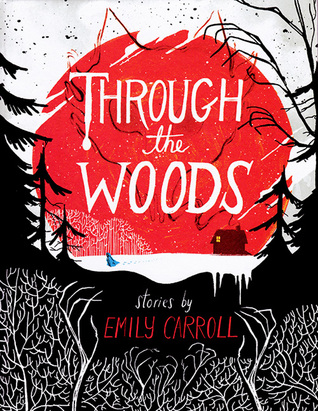
Through the Woods by Emily Carroll

Through the Woods is a collection of five graphic short tales. By graphic, I use the term like in 'graphic novel' - i.e. the tales are illustrated. I would not call these 'comics' - there is a slow and deliberate artistry in the illustrations and text here, and it is, after all, a hard-back book.

These are beautifully sinister and creepy fairy tales. I do not mean they are tales for children: I would be very cautious before giving this book to a child. They are tales of horror. When I call them fairy tales, I mean that they draw very archetypal characters, and they draw on very archetypal fears and story structures. That makes them all the more powerful: there is something universal about the terrors in these stories, and they resonate with all the things that probably scared you when you were little. (Except spiders: there is no appearance of spiders at all in this book)

Some of the stories leave the horror just off-page, so your imagination fills in the blank with bone-chilling effect. Others put the horror very much on the page, so you shudder at the creepy illustrations of creepy ideas.

The illustrations use black, white, and red persistently - all other colours are slightly faded, slightly subtle. And one archetypal, universal theme of horror in this book is teeth: whenever we get a close up of teeth, devouring, smiling, fletching, tearing... there are terrible teeth in this book.

Oh, these stories are wonderfully, deliciously dark, beautifully written and beautifully illustrated. Five tales, each one a gem, and the book about as perfect as it could be.


Highly recommended.

Rating: 5/5

PS: If you'd like a preview, you can read one of the tales on Emily Carroll's website: His Face All Red

Cardiff Book Club: book choice and meeting locations

I just sent out a quick book club update by email.
  • So far, 11 people (including myself) are interested. 
  • Three people can’t make either of the suggested dates  
  • Seven people can make it on the suggested Tuesday
  • Five can make it on the suggested Sunday
  • People have suggested venues in Roath, central Cardiff and Chapter. (I’m afraid I’m claiming organiser’s privilege and not going to include Canton / Chapter in the short list, as that’s awkward for me to get to)
  •  “Lock In” is now well in the lead (7 to 4). It’s the more popular option for those who can make Sundays and also for those who can make Tuesdays. To give people time to read it, let’s firm up the choice now: Lock In by John Scalzi is our first book!

I figure the sooner we fix a date, the better. So…

  • I’d like to check if more people can make the first meeting if it’s on a later Tuesday or Sunday. Could you let me know? Please use the form: https://bastianbalthasarbooks.wufoo.com/forms/cardiff-speculative-fiction-book-club-2/
  • I'm also trying to find out whether Roath or Cardiff Town Centre is the best place for meetings.
  • I’d like to see if another day of the week would be better for more people in the long run (i.e. for second and further meetings). I excluded Wednesdays as an option because there’s an existing speculative fiction book club which meets on Wednesdays
  • Would you like to help out in some way? Please let me know!
  • Please do feel free to tweet / share on Facebook / spread the word to any local fellow SFF readers you know. Here’s a link that should include all book club updates on  my blog: http://www.bastianbalthasarbooks.co.uk/search/label/book%20club

I'm also going through my previous blog posts and replacing links to the registration form with links to the new form.

By the way, do feel free to say hello in the comments!

Thursday, 29 January 2015

Cannonbridge by Jonathan Barnes

Cumberba... erm, I mean, Cannonbridge.
"Something has gone wrong with history," the blurb on the back of Cannonbridge promises. It's an intriguing premise. In the world of this novel, a famous British writer, Matthew Cannonbridge, connects all the famous writers and figures of the Victorian / Fin de Siecle literary age. He was there when Doktor Frankenstein was conceived by Mary Shelley. He met, inspired, and interacted with every major writer of the age. He is the canon bridge. Except, what if he never existed?

Toby Judd, our present day hero, is an unknown academic, a professor of literature who has not made a big name for himself. The novel starts with a rather devastating experience: his girlfriend leaves him for a more successful pop-academic, whose new work about Cannonbridge is annoyingly bestselling and shallow and populist. Devastated by his humiliation, Toby suddenly has an epiphany: Cannonbridge never existed! He's a literary hoax! And Toby promptly uses his inaugural professorial lecture to present that hypothesis, before being interrupted a few minutes into his raving rants and kicked out of his university for being a lunatic.

Only he isn't mad, and suddenly those who believe in a conspiracy start dying...

Meanwhile, in the Victorian age, Matthew Cannonbridge meets one famous writer after another, and grows increasingly sinister in aspect.

I really enjoyed Jonathan Barnes' first novel, The Somnambulist, but did not enjoy its sequel, The Domino Men. When I saw that a new standalone novel is coming out, I was curious. The premise sounded promising and intriguing. Unfortunately, Cannonbridge was a bad disappointment.

Our hero, Toby Judd, is a bit of a wet blanket. That's fine, but there is no logic behind his sudden conviction that Cannonbridge is a hoax. He just suddenly has a feeling that Cannonbridge  has no reality, and then he irrationally decides to base a lecture on that feeling without being able to properly rationalise his own theory. That seems a bit unconvincing.

Logic is, in fact, in very short supply in the novel. As in: there is no internal logic whatsoever. There is a big conspiracy killing people, not because it makes sense for them to kill people, but because people dying is necessary to give the plot some momentum and drag Toby out of his academic exile.

Meanwhile, Matthew Cannonbridge pops up all over the Victorian place without actually having a clear effect. The central plot is that Matthew Cannonbridge is the writer of his age. Yes, he has encountered all the others, but it's his works (rather than theirs) which is most well-remembered. He is, in effect, the Shakespeare of that age (writing prose rather than drama), only of course he never actually writes anything - he has written, without having to go through the writing. The problem is that it's never clear whether the works of his contemporaries still exist (in the form they do in our world) or not. If they do exist, then there is no compelling reason why Cannonbridge's writings have eclipsed all the others. If the other works do not exist - if, in fact, he somehow detracts from all the writers of his age by meeting them, passively leeching creativity and influence and fame off them - then it hardly matters that he met them all, and it would not matter much to his fame. Unfortunately, I have no idea which is the case - he seems to meet the Shelleys the night that Frankenstein was first conceived, and it seems as if that meeting results in the book never being written, or not in its famous form - but he meets most of the other writers mid-career or even towards the end of their careers.

I found Cannonbridge a struggle to read, not because of any difficulties with the language or ideas, but because it soon became very frustrating and repetitive and boring. For a long while, the basic pattern is:


  1. Toby meets someone. That someone dies.
  2. Cannonbridge meets someone famous, and is so inherently charismatic that he makes an impression on them, then he disappears.
  3. Reiterate.


Later on, the novel aims for a sense of the uncanny. A strangely calm but super-effective hitman, a sinister island, some monstrous events... the sort of things that I suspect are Lovecraftian (I still haven't read more than one Lovecraft short story, so I still use that term second-hand or third-hand). Perhaps even a bit like Lost - a build up of uncanny that has no internal logic whatsoever.

Unfortunately, the novel never really succeeds at building up tension, or horror, or anything but exasperation. The final resolution is... well, silly would be the word I'd choose, and the final twist is an excuse for shoddy writing in earlier chapters. Truthfully, I only finished it because I got a free copy through Netgalley and felt obligated to read it all the way to the end so I could write a review.

I'd give this one a miss.

Rating: 1/5

Tuesday, 27 January 2015

Bête by Adam Roberts

Adam Roberts is an author whose career confuses me. Mostly, it confuses me because not as many people know of him and his books as I expect.  Maybe he's one of those authors read keenly by some dedicated British science fiction readers, and by other writers, but who remains perplexingly ignored by mainstream readers.

Like many of his SF novels, Bête is very high-concept. However, it is also one of the most accessible book he's written. (All of his books are accessible - but they all take a fairly serious, rigorous approach to their ideas. Bête stands out because there's a surreal sense of humour suffused through the book.)

The novel starts with a dialogue between a farmer and his cow. The dialogue is happening because of animal rights campaigners and the continued exponential cheapening and shrinking of microprocessors: chips have become so ubiquitous that even cotton buds are digital (and analyse the consistency and health implication of earwax). So, with computing having become that cheap, animal rights campaigners have developed chips that can be implanted in animals' brains. These chips interact with the brain tissue, and enable the animals to understand (and mimic) human speech - provided their mouths are capable of fine muscle control. The campaigners claim this gives a voice to the oppressed animals. Their opponents claim it is merely a trick - it is the chip doing the thinking and talking, the animal is merely a carrier.

The dialogue between our protagonist and his cow is taking place as he is preparing to slaughter it - an act which is temporarily banned by an injunction while courts sort out whether to recognise talking / chip-equipped animals (bêtes) as having rights. It's a gripping, entertaining, surreal scene, and it starts the novel beautifully. 

Soon, changes are coming. Bêtes gain rights, and so campaigners spread more and more chips into animals in order to protect them. The chips are designed to pass into the brain if consumed - so predators become chipped if they eat any bêtes.

Animal husbandry is the first thing to pass into history, and with it, our farmer's career and livelihood. For a while, he becomes a spokesperson for a future equivalent of the Countryside Alliance - right wing conservatives with a traditions-fetish and a sizeable measure of bloodlust. He's not really taking that job from conviction: as the last person to kill a bête, he is simply a convenient figurehead for them, and he needs a job. But that is just a phase, and quicker than anyone could have foreseen, his life changes into that of an itinerant butcher (travelling from town to town and providing butchery services), and ultimately, a vagabond. Later in the novel, a kind of plague is spreading among humans, which brings society down to its knees.

One of the striking things about the book is how verbose almost everyone is. Our farmer is also an aspiring poet. The bêtes all have a very verbose way of speaking - the result of the chips being developed by animal rights campaigners, who presumably spend a lot of time having lengthy pseudo-academic and philosophical conversations and taking themselves very seriously. Only the women we meet are sparse with their speech and interested in getting by / living rather than ideas and discussions, while all the men are opinionated and verbose. I don't know whether this was a conscious choice by the author, but it certainly gives the book a strange atmosphere: there's more ideas exchange between man and bête than there is between man and woman. In the book, men and beasts are thinkers; women aren't. Maybe women simply choose not to waste their energies on lengthy discussions about things they are unable to change, but it still makes for a striking, not entirely comforable contrast between the sexes in this novel. The sex of the bêtes is never really relevant to their speech - their consciousness is almost sex-less, or rather, its sexuality is very very different from that of humans.

Throughout the novel, the farmer meets people with different takes on animals, and animals with different takes on themselves (and people). The story mulls big questions around (artificial) intelligence, humanity, and identity / souls, while depicting a society that's sliding towards collapse. The sense of whimsy that defined the opening chapter is gradually replaced by bleakness and crisis. To some extent, the crises society is facing are a bit too catastrophic - the plague (sclery) in particular didn't quite fit with the rest of the plot, in my opinion.

Bête is an uphill read: it hooks you in with a magnificent start, keeps you reading with its unique take on talking animals and the surreally funny situations this leads to, but all the while it keeps adding to the burdens of its hero, its world, and your mind as you read it. 

I am beginning to think I might be stumbling onto the thing that stifles Adam Roberts' commercial potential: all his books are high concept, full of fascinating ideas, and smart. But they tend to have a certain hopelessness at their core - they spiral into a fretting, depleted mindset, which can take its toll on readers. This is a bit unfair: novels this smart deserve to be read, even if they aren't easy to digest. 

If you've never read any Adam Roberts novels, I think Bête might be the best one to start with, simply because it lightens the load of its thoughts with a wry sense of bemusement. (My second recommendation would be Salt, which is also very good).

Rating: 4/5

PS: If you enjoy Adam Roberts' novels, then I'd recommend another book which struggles to get the readers it deserves because it's hard to digest. You should try the very, very smart and masterfully written Random Acts of Senseless Violence by Jack Womack. It's not as high-concept in terms of its scifi, but it's staggeringly predictive of what life in a global financial crisis and long recession is like. 

Monday, 26 January 2015

Cardiff Book Club Update


I thought I'd post a quick update about my attempts to start a Speculative Fiction Book Club in Cardiff.

Here's how things are going so far:

  • You can look at the registration / voting form results in an online report. It has colourful charts! (Not sure if it updates "live" - i.e. the data could at times be a little behind). After Lock In's early lead, The Invisible Library has caught up and is now neck-and-neck with Lock In! 
  • I've had some flyers made, which I am putting in booky places around Cardiff today (Monday, 26th Jan 2015). See above for what the flyers look like. As I don't have professional software on my home PC, I had to resort to MS Word to create it, so please don't judge it too harshly!
  • IMAGE CREDITS: I used creative commons photos from FlickR for the flyers. These are:
  • I'll email those who indicated they can't make it but would still like to join today or tomorrow, to figure out what the best options are.
  • I'll send out a proper email update to everyone who registered by the end of this week.
  • If you're interested but haven't signed up & indicated availability yet, please do so: here's a link to the sign-up & voting form. [edited: a time, place and book for the first meeting has now been announced. You're very welcome to come along, but the web form is no longer needed]
  • In the meantime, I'm grateful for any and all assistance with spreading the word, whether on Twitter, Facebook, or everyone's own blogs. 

I've also been contacted by two people who let me know there is already a Speculative Fiction Book Club in Cardiff, which has been running for seven years. I'm still going ahead with my attempt to start a new one: I think it's nice to start up something with an entirely new group where no one feels like an outsider as everyone is equally new. So far, it looks like there may be enough people interested for a brand new book club to work. However, if this attempt should flounder, or if the date we ultimately settle on for meetings does not suit you, it's good to know that there is another option that people can join (they do accept new members). The other book club meets "around 7ish in the Rummer Tavern on the 1st Wednesday of the month. The next meeting is February 4th, and the book is Ancillary Justice by Ann Leckie".