Tuesday, 20 January 2015

Cardiff Speculative Fiction Book Club 2.0

UPDATE (March 2015): If you'd like to get involved with the book club, please see the Book Club page for the latest details & to sign up!

UPDATE (1st February 2015): As Lock In got a convincing lead, it'll be the first book to be discussed. 

posted about the possibility of launching a Cardiff-based book club / reading group with a focus on speculative fiction, but probably made things a bit too complicated (and the time frame for a first meeting a bit too short)
I would still love to have a speculative fiction reading group around Cardiff, but to give it a proper shot, I decided to take a little more time to get this going. That way, I can make a half-decent stab at promoting the first meeting.

Over the next fortnight, I’ll produce a few promotional postcards and ask people to share this post around on Twitter etc.

If you'd be interested in joining, please fill in the form at the end of this post. 


Meeting Logistics

To keep things simple, I figured we could either meet on Tuesdays (early in the evening) or on Sundays (in the afternoon), once a month or so, with the first meeting around the end of February / the start of March

If you'd like to join but can't make it at those times, please don't be shy - let me know and I'll see if alternatives would be more popular!

Book Choice

I figured I'd suggest two books that we can choose from. I'll leave the poll open until 8th February - that way, there should be enough time to get and read the winning book. (I may post updates earlier - especially if there's a clear favourite early on).

Which of these books would you rather read and discuss?

  • The Invisible Library is a light read. A bibliophile has swashbuckling adventures featuring parallel dimensions, magic, vampires and a steampunky Victorian London! It's great fun - but not by any means a challenging read.

  • Lock In is a good science fictional whodunnit crime novel. It's set in a world where some people have suffered a debilitating disability - similar to lock in syndrome - but science enables them to control (and experience life through) avatar robots. It's a novel full of ideas and offers rich grounds for discussion - but it's accessible and not too challenging.

Update:


Thursday, 15 January 2015

Adventures in Time and Space with Max Merriwell by Pat Murphy

Adventures in Time and Space with Max Merriwell is a bit of an odd book. The story takes place on a cruise ship, where Susan, a recently divorced librarian, and her friend Pat, a physics research student, are travelling from America to Europe on a repositioning cruise. They meet Max Merriwell, a science fiction author who also writes fantasy as Mary Maxwell and gritty crime novels as Weldon Merrimax. But all is not as it seems, and as the ship heads for the Bermuda Triangle, people who should not be aboard - who should not even exist - appear to be involved in some dramatic events...

I did not know it when reading it, but this is actually the final volume of a larger project. I have not read the precursor books, so I can only read it as an independent work. As such, I must admit I had higher hopes for the novel. The title sounds promisingly adventurous, but the story does not quite live up to that.

If I hadn't read the superb The Falling Woman, which was written much earlier, I probably would have thought this one to be a writer's first novel. It's a novel about writers, and imagination, and about creative writing and workshops. The protagonists are young(ish), and they have that hard-to-define quality of characters in young writers' novels: they may have jobs and some back story, but they don't quite come across as the people who match their own back stories. Their personalities match their jobs a little too well, to a point where they feel a bit like the 'default' people for their particular jobs. They don't surprise the reader very much - in fact, 'default' is a word that fits this novel a bit too much.

As the novel (and the ship) progresses, events become more and more chaotic, until it becomes clear that the book is essentially a literary thought experiment that turns quantum physics into a macro-scale event - like Schroedinger's Cat, only more so. In fact, towards the end it feels a little like a popular science physics text which has been turned into narrative.

The end result is a novel that doesn't really fizz and sparkle, and which isn't as absorbing as a good novel should be. It's all very clever, very quantum, very meta, but none of those things make a good story on their own, and the characters inside this novel just are too 'default' to make the story shine.

Rating: 3/5

Wednesday, 14 January 2015

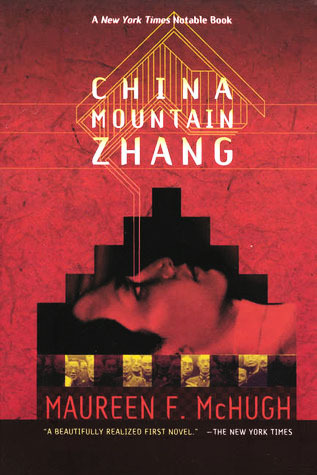
China Mountain Zhang by Maureen F. McHugh

I read China Mountain Zhang because of Jo Walton's What Makes This Book So Great - a book of recommendations for SF novels. Jo Walton's thoughts about China Mountain Zhang intrigued me.

As a matter of fact, her review is so insightful and clear, I agree with her comments almost entirely. So I'll cheat a little in my own reviewing: please go and read Jo Walton's review first.

(...)

(...)

Okay, read it? No? I was serious...

(...)

(...)

Right. Now that you know the gist of it, I can point out the things I felt a bit differently about. For one, I didn't quite get that "collection of short stories" feeling from this mosaic novel. I don't read many mosaic novels. Off the top of my head, the one mosaic book that I recall reading is Behind The Beautiful Forevers - and that is a work of non-fiction. So it's not a style I am very familiar with. To me, China Mountain Zhang did not feel like a novel, nor like a collection of short stories, nor even a combination of the two. Instead, it felt like I was reading chapters from completely different novels (set in the same world) that had somehow been put into one book. Each chapter threw me into an ongoing storyline, each chapter ended without conclusively ending a storyline. The first section did feel like the most substantial thing - like a novella, I guess, or like Act One of a Three Act Play. But after that, no chapter, no plotline develops in traditional story arcs. One chapter might fit into Act Two of another novel (which just happens to have a slight overlap with this one), while another might come from Act Three of a different novel entirely.

A perfect example would be the chapter written from the viewpoint of a kiteracer: by this point, we have been in kiteracing audiences in other chapters. We have even encountered kiteracers in passing. But where she comes from - and what happens to her after her chapter is done - is left entirely open. We get a chapter that feels like it belongs in a novel about kiteracers, one chapter only, no more, no less, and it's a middle chapter, not a beginning and not an end.

Jo's review is absolutely right in saying that this novel keeps you reading on, even though no one goes on any quests, no one gets to have big adventures, and everyone has to get by and work and muddle through. (My paraphrasing). As someone who likes his book a little more swashbuckling and escapist, the understated drama of the book left me expecting some big developments - I constantly expected some big revelation around every corner. Instead, the book stayed very down-to-Earth in its dramatic developments (even though some of it takes place on Mars). Yes, characters make life-altering decisions, but it's mainly their own lives they affect, and the lives of those closest to them. No one affects the world. No one is more than a little cog in a giant machine.

It's clearly an intelligent book, and it has high literary merit. Every character and every development is entirely believable - including the future society of near-global Chinese Socialism.

That said, the book was a little too literary for my tastes. It turns out that understated, small dramas about small people are probably the things I want to escape from, just as much as the mundane world of working in an office in the 21st century. China Mountain Zhang is an impressive work, but one of its achievements is to put the exact kind of literature that I am least interested in, into a science fictional world (i.e. a genre that piques my interests). So I cannot really love this book.

Rating: 3.5/5

Tuesday, 13 January 2015

Lock In by John Scalzi

Lock In is a science fiction novel set in a near-future. Cars drive themselves, but other than that, the world is very similar to our own. One key difference: after a devastating side effect of a global flu pandemic, a significant number of people suffer from lock in syndrome. They are unable to control any aspect of their bodies, but their minds are fully functioning. So a huge programme of funding has created three solutions to give them fuller lives:

  1. They can link up remotely with a robot avatar, which interacts with the world on their behalf. The robot feeds them sensory input, and they control it, to a point where their experience of the world is similar to that of a human - except they have the internet more or less built-in, so they can access information internally, make voice calls to others without making a sound, and control how much pain they actually want to feel if the robot gets damaged. These avatars are called Threeps (after C-3PO), or, derogatory, clanks.
  2. A tiny number of people had a different side effect from the flu: their minds have become open to let others in. So the locked-in can, if they have the cash, download their own minds into a real human body, and experience the world through a human avatar. However, the owner of the body is never entirely gone, and can take control back, and this is much more expensive than using a threep.
  3. There is a virtual reality just for Locked In people, called The Agora, where they can meet, interact, and have their own personal space.

Our hero, Chris Shane, is one of those locked-in people. (They're called Hadens in the book, as their condition is called Haden Syndrome, after the US president whose wife got the condition while he was in office). We start the story on his first day working for the FBI, joining another agent to form a team of two focused on Haden-related cases. It's also a day of a Haden strike, as the government is changing the subsidies and funding for Haden sufferers (threeps are, after all, not cheap).

Of course, his (or her?) very first case is a murder. (While reading, I was sure that Chris is a guy. I'd swear that it was explicit at some point. Except, a review by Pat Rothfuss suggests the audio book exists in two version, one with a female narrator, one with a male one. This makes me wonder whether our narrator's sex might have been left more ambivalent than I thought... after all, "Chris" could be short for Christine.)

The world is introduced in a clear, concise infodump, right at the start. Basically, before the story starts, we get a school text book revision notes of the history of Haden's Syndrome, and within two pages or so, we know pretty much all the background that's needed. The rest is revealed casually and deftly, but easily accessible. It's not the sort of scifi novel that throws you in at the deep and and enjoys your disorientation.

The story is, of course, a whodunnit. Along the way, we learn more about the world, more about the different perspectives (of Hadens about others, and of others about Hadens). Characters occasionally discuss politics and change and what should or should not be done for Hadens. Should there be work to 'cure' the condition, or should all efforts be about enabling people who have it to function without physically altering them? It's a debate that reflects one about deaf culture (should there be more work aimed at enabling deaf people to hear, or more recognition of sign language, lip reading and deaf culture as just one different culture living in a multicultural society, with efforts to enable deaf people to live independently and successfully among us, but no efforts to make them hear the rest of us?). 

Lock In is a novel with simple, straightforward prose, clear dialogue, people discussing things - it is not a book that dazzles you with style, but it is a book that draws you in with ideas. One very obvious thing is that it doesn't present the locked in characters as victims. They may have some vulnerabilities, and they may have been badly afflicted when the condition first arose, but by the time of the story, they have successfully become fully functioning citizens.

Our hero is rich, his threeps are ultra-modern models, and he isn't shy to download himself at a moment's notice into a borrowed threep in a different part of the country, or use his internal gadgets to record video and audio and 3D scans. He is living in his parents' mansion, but looking to move his threep into a flat share with other threeps. Some Hadens might have to survive with unreliable threeps, parked in depressing wardrobe-like boxes to recharge, but that's a rich/poor divide, not an inherent victimhood. And just as the Hadens aren't victims, but highly capable individuals who can be very empowered by technology, they are also mixed people. Our hero is smart, brave and good, of course, but we also encounter firebrand campaigners, selfish egomaniacs, and at the very heart of the murder case, a cold-blooded murderer. Hadens, in short, are people. Good people, bad people, rich people, poor people. Some aspects of their lives are quite different from the rest of us, but in a way those are mere logistical matters. (Perhaps that is all 'culture' boils down to: the logistics of interaction - the rest is just humanity).

I enjoyed reading Lock In. It's thoughtful, engaging, and entertaining. Some things are never really expanded upon to the extent I had expected (I had expected more things about / in the Agora), and there are never really enough suspects in the story (it's not like those TV crime shows, where every character would have a motive), but it's a thoughtful book packing complex ideas into an entertaining whodunnit (without telling us what to think).

Rating: 4/5

Monday, 12 January 2015

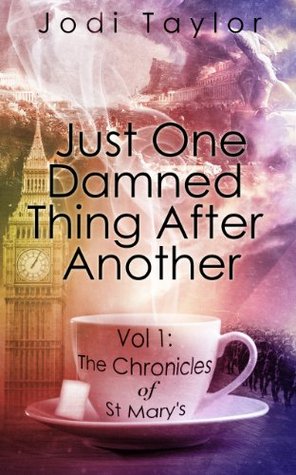
Just One Damned Thing After Another by Jodi Taylor

Just One Damned Thing After Another has a cheerfully irreverent title, a low price on Amazon Kindle, and an energetic back cover blurb to recommend it. It's the sort of book you buy on Kindle despite a godawful cover that looks as if it could have been the work of a self-publishing author, simply because you can't go too far wrong for 99p or so.

Fortunately, it is a lot better than its cover would suggest. Our heroine and narrator is a historian who is offered a unique opportunity: to join an altogether more experiential research institution. St Mary's Institute is actually a time-travelling outfit, sending historians to the past to witness events (and give their sister institute an advantage with their more traditional research).

The story moves with all speed and a quirky energy, bouncing around its plot like a manic, quirky academic. It probably owed quite a bit to recent incarnations of Doctor Who: the restlessness, the habit of visiting history, the sense of humour, and also the drama, explosions and cavalier attitude towards life and death. This is a book where dozens of characters have - very briefly - names, but few actually stick around long enough to make any impression at all. Most are only there to die quickly - red shirts, cannon fodder, call them what you like. Our narrator might (very very briefly) mourn them, but as we never really noticed them in the first place, their replacements and deaths hardly matter to the reader.

The book has another awkward habit: for a book about time travel, the plot's own timeline is not nearly clear enough. Between one chapter and another, several years pass, and yet that is not explicit or obvious. The book doesn't bother with "the boring bits" of the tale, but when the story cuts from basic training to final exam and then to some missions years later... and then skips some months... basically, things need to be a lot more continuous and clear.

All that said, it's a very pleasant, pacey and fun thing to read. It's a guilty pleasure: shallow and largely predictable, but swashbuckling, tongue-in-cheek and fun. A slightly girly equivalent to Doctor Who.

Rating: 3.5/5

Sunday, 11 January 2015

Conjugal Rites by Paul Magrs

As a reader, my awareness of the publishing industry and its trends is patchy: I notice some big trends sometimes (kinky porn, ever since 50 Shades, and general popularity of Young Adult and 'Forever Young Adult' literature - books that have YA-style plots and pacing, but grown-up characters), but other trends pass me by.

So, is there a trend for "senior citizen young adult" literature out there? If not, then I suspect Paul Magrs may sneakily have been carving out a genre for himself while everyone else wasn't paying attention.

I enjoyed the first two Brenda and Effie mysteries without ever thinking about its genre. Cheerful, light-hearted gothic fun, with fairly pacey plots, a mischievous disposition, and older protagonists. But that alone would not make a new genre: the 100-year-old-man-who-climbed-out-of-a-window-and-disappeared, for example, is hardly a book aimed at an older audience.

It's not until I read Conjugal Rites that I started to suspect that something a bit unusual was going on.

Brenda and Effie are both older ladies. Brenda, we find out in the first novel, was created by Doktor Frankenstein, intended to be the bride for his first creature. However, she has fled from that fate, and, after hundreds of years of trying to find a way to fit in, she has set up a B&B in Whitby. Effie, her neighbour, is a spinster and a descendant from a long line of witches. She's a bit fierce, a bit gullible, but very close to Brenda. Together, they have gothic adventures, whether being seduced by Dracula or trying to uncover the sinister secrets of a con man who makes women younger. The two big old hotels in town each have their back histories and charismatic owners (the sinister and evil Mrs Claus, running a Christmas-themed hotel with cannibalism and enslaved elves, while the other hotel is run by the widow of an elderly London-based Chinese Criminal Mastermind and Supervillain). It's all gloriously playful with gothic tropes, and good fun.

In Conjugal Rites, some of Brenda and Effie's former adversaries are again up to no good. One is running a night time talk radio show that somehow compels everyone to spill personal secrets and tell the juiciest, most indiscrete gossip about each other, while another has arranged for a suspicious congress for retired superheroes. Worst of all, it looks like Brenda's oldest adversary has been summoned to town...

While reading the book, some things jarred a bit: frequent repetition, and a habit of summing up everything that has happened so far every other chapter or so. It's almost like one of those TV shows, where, right after the ad break, characters quickly discuss something that happened previously, so that the audience remembers the context for the next scene. At first, I thought this was slightly clumsy writing and I recalled that similar things had bothered me a little in previous volumes. Then a penny dropped: what if it was not clumsy? What if, in fact, this was a planned out strategy? The regularity of these little plot-summary-moments was just too carefully timed. Suddenly, the somewhat strange look and feel of the covers of these books started to make sense. The larger format, too. I read this one on Kindle, but I'd now bet that these books were all printed in slightly-larger-than-standard print, with a bit more spacing between the rows. I'd been reading books written, designed, printed, and created for an elderly audience with weaker eyes and a need for memories to be frequently refreshed. I'd read several volumes without ever suspecting that I was not the target audience.

Maybe there are many books like this series out there. Maybe this isn't new to anyone else. Perhaps I was the only one thinking that older people were mostly targeted by Mills & Boon and Danielle Steel and all those lavender-y, awful-looking romance books, rather than anything fun and adventurous. In that case, shame on me. I used to enjoy watching Murder She Wrote and Columbo and other crime movies meant for older viewers; I should hardly be surprised that there are gothic adventures written explicitly for them, too. (I think someone should make te Brenda and Effie books into a TV series: clearly, with the ageing population, they should have a ready-made market ready)

Once I got past that realisation, the book continued to be pleasingly diverting. There are some aspects where I wanted things to go down a different route: hell features in this novel, but it is not a hell that convinced me. Worse, the entire plot arc about Brenda's erstwhile suitor was uncomfortable and troubling to read. (For a Brenda and Effie novel, there really isn't enough Brenda in this one...)

So, not quite up there with the first volume in terms of its fun, but still a pleasing novel - and the only young-adult-for-senior-citizens series of gothic adventure novels that I'm aware of. Hats off to Paul Magrs for eemingly creating an entire market niche, which he totally owns!

Rating: 3/5

Saturday, 10 January 2015

A SF/F Book Club for Cardiff?

UPDATE: Please see my new update about this (posted January 20th 2015)


Someone asked on Twitter if there are any book clubs in Cardiff. There are... but I'm not aware of any focusing on science fiction, fantasy and other speculative fiction.

So I figured I'd try to see if there's any interest in starting one?

Here's a Doodle to help schedule a first meeting (Link Removed). (Probably just a meeting to suggest & pick books, and firm up times and locations for the book discussion meetings)

(I'm away the first week of February... I imagine the book club could meet monthly after the first meeting.)

Who's interested?

(If none of the times in the Doodle suit you, let me know, and propose other times that would suit!)

Also, if you're interested, please feel free to get in touch in the comments or through the email form on the right!